|
ARRL Solar Report for Thursday April 2, 2026
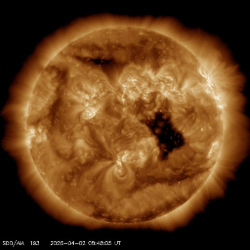
Solar activity has been at low levels with only C-class flares produced by Regions 4401, 4405, and 4409. There were 9 numbered active regions on the solar disk, with 4409 showing the most significant growth during the period and producing the largest flares on April 1. A new region emerged but it has not yet been numbered.
Multiple filaments erupted during the day on April 1, producing coronal mass ejections (CMEs) observed in coronagraph imagery, but their propagation modeling did not suggest impacts to Earth. The exceptions are the ejecta first observed at GONG H-alpha images on April 1.
Solar activity is likely to reach moderate (R1/R2-minor/moderate) levels, with a slight chance for X-class (R3-strong) flares through April 4, due primarily to the flare potential of Regions 4404, 4405 and 4409.
Solar wind parameters were near nominal levels with solar wind speed averaging around 440 km/s. Enhanced solar wind disturbances are likely through April 2 due to the arrival of the March 30 CME. Conditions are likely to give way to coronal hole high speed stream (CH HSS) activity by mid-to-late April 2.
The 10.7-centimeter flux: April 2, 155; April 3, 150; April 4 – 5, 145; April 6 ,135; April 7, 125; April 8, 118.
Predicted sunspot numbers: April 2, 109; April 3, 104; April 4, 115; April 5, 101; April 6, 119; April 7, 95; April 8, 124.
For more information concerning radio propagation, visit the ARRL Technical Information Service, read A Quick Guide to HF Propagation Using Solar Indices, and check out the Propagation Page of Carl Luetzelschwab, K9LA.
For customizable propagation charts, visit the VOACAP Online for Ham Radio website.