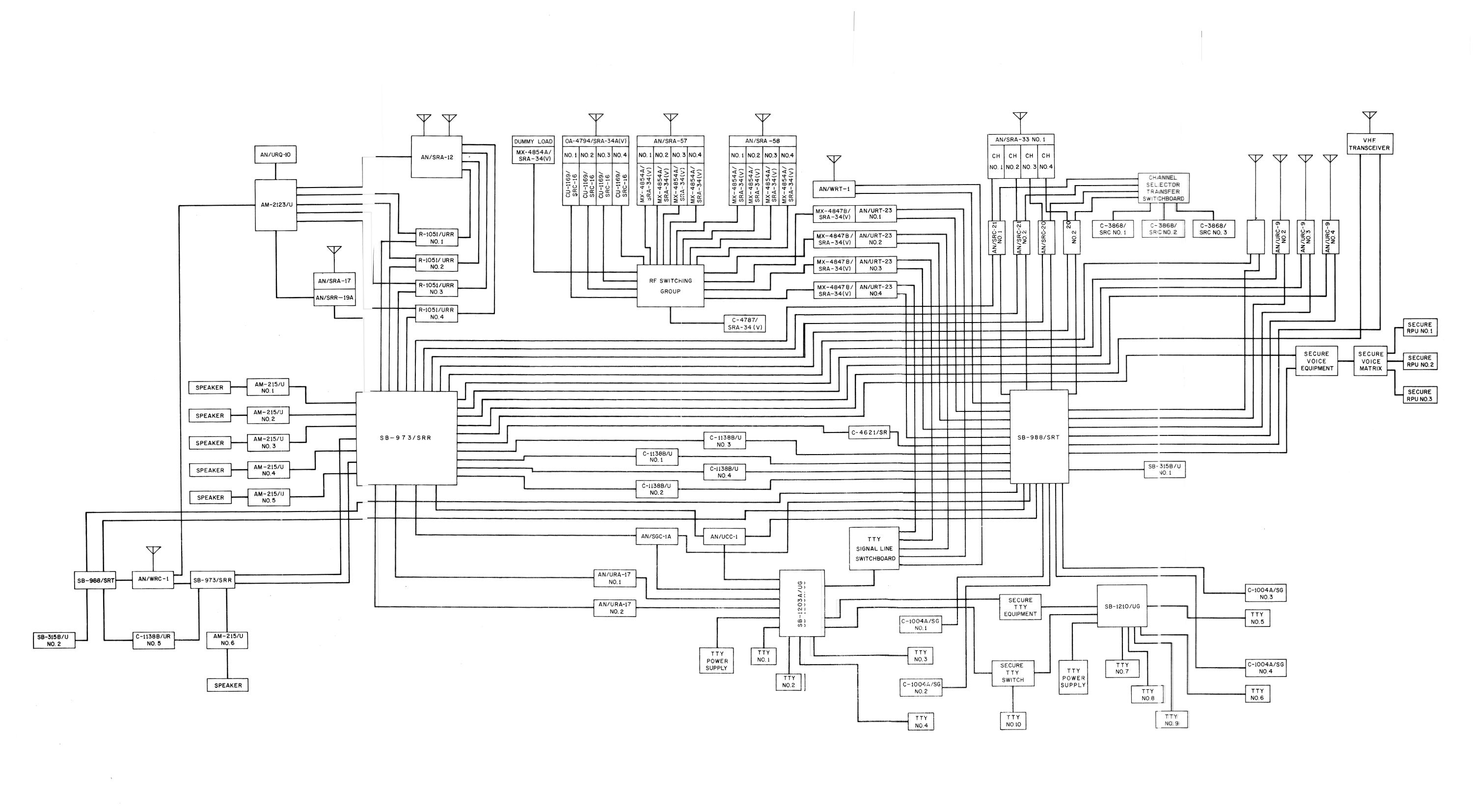
In digging into a M28 ASR, I think I have stumbled across some of
the differences between Army & Navy TTY communications. All the
schematics for M28 KSR & ASR units that I have seen, show just
one loop, tying the TX & RX circuits together. (Aux reperf in a
M28 ASR typically has its own loop.) M28s are wired such that they
are very flexible and can be wired to separate TX & RX circuits,
but that is typically not how they are shown on system drawings. Th
AN/UGC-6 (M28ASR w/aux reperf) schematic (fig 12-38 from the Navy
manual ) does not show an option for full duplex (separate TX &
RX loops) operation.
Nick says that full duplex was not used much (if any) in the Navy
TTY comms, but his page,
https://www.navy-radio.com/circuits.htm
does mention full-duplex operation.
In 1950, the Army (and Army-Air Force) started buying Kleinschmidt
equipment exclusively (although they did buy some M28s later.) All
the Kleinschmidt units, TT-4, TT-76, TT-98, AN/FGC-25 were set up
for full duplex operation with separate cables or jacks for TX &
RX. The standard Army wire-line modems (TH-5 & TH-22) used with
the TTYs were capable of both simplex (2-wire) and full duplex
(4-wire) operation. Mobile RTTY huts (AN/GRC-26, -46, -122) could
all be operated full duplex, though simplex was the norm. (the
AN/GRC-142 is a simplex GRC-122.)
I was a TTY repairman in the Army Security Agency. In Viet Nam in
1967. I was in the 337th Radio Research Co., supporting the 1st
Infantry Division. We were located near the Division HQ and had
outstations (AN/GRC-46 huts) positioned with the forward located 1st
ID Brigades. We also had a link to our battalion HQ and that link
carried a lot of traffic; so much so that it was run in full duplex
mode, with messages going in both directions, simultaneously.
The outstations had tape facilities (TT-76s), but our company comm
center just consisted of a hut (AN/MSA-?) with four TT-4 printers,
4-5 KW-7 crypto units and four TH-5 modems in it. So all outgoing
messages had to be typed on-line. Imagine typing a message on a
printer while another message is being printed!
The Army did have medium-sized comm centers in trailers or vans and
big, fixed station comm stations, but I never saw them. I did work
on a 12 channel tape-relay center that was in a 38 ft trailer..
So maybe some of the difference between Army & Navy operation
was due to the Army units being smaller and more spread out; vs. the
Navy with concentrations of operations on big ships. The Navy's use
of multiplexed RTTY may have given them enough channels that they
did not need to operate full-duplex.
Just some thoughts.
Have fun,
Duncan
K2OEQ
31J30
On 08-Apr-23 16:24, Nick England wrote:
See also
They just weren’t used in full duplex
(except if the aux typing reperf was independently
connected). Normal installation was to the C-1004 box that
you manually switched from CFS REC to CFS SEND. (The TONE
position was for hookups that automatically keyed the
xcvr, usually UHF).
I guess I just don’t understand when you
would run full duplex using a single TTY.
If you wanted to receive while
transmitting you just used an additional TTY printer or
reperf.
Read more about the Navy’s view of RATT
And