From: Jim Haynes [
[email protected]] -- Thursday, March 16, 2023 7:21 PM
> The Teletype Inktronic (what a name!)
I have fond (well, not quite) memories of using an Inktronic when I had a summer job at Bell Labs in 1973 and 1974.
> worked by electrostatically deflecting charged droplets of ink
> in two dimensions. It had 40 nozzles and sets of deflecting plates
> to print 80 columns on 8 1/2 inch wide paper. A brilliant concept,
It was very fast. We had a little local area network, 3 workstations, 1 file server, using Honeywell 516 minicomputers. The workstations each had a graphics display and a home-made mouse. For a while, the Inktronic printer was the only fast printer for the
network, with Teletype Model 33 ASRs as console keyboard-printers on each workstation.
> a fiasco as a product. The high voltages on the deflecting electrodes
> attracted paper dust which distorted the printing.
Each droplet tended to pull a slim tail of ink behind it, so the dots on the page, under magnificaiton, all had fine little blue tails. And as the electrostatic fields began to distort, droplets started getting hung up on the deflection plates. Inevitably,
you'd end up with a gob of thick blue ink somewhere on the freshly printed page, which then transferred to your hands, clothing and everything around you.
> Attempting to clean the electrodes usually resulted in bending them.
They weren't all that flimsy. The trick was to use a Q-tip cotton swab and lots of solvent to soften the ink globs before very gently wiping them off.
> Hence the printing was legible at first but deteriorated as time went on.
I never saw it get illegible, but I was glad when we got rid of the TTY equipment and got Diablo Hi Type daisy wheel printers and (sadly) wet process electrostatic printers (Tektronix? I forget the brand). i say sadly because the smell of the solvent from
the freshly printed wet copy was pretty vile.
Doug Jones
[email protected]
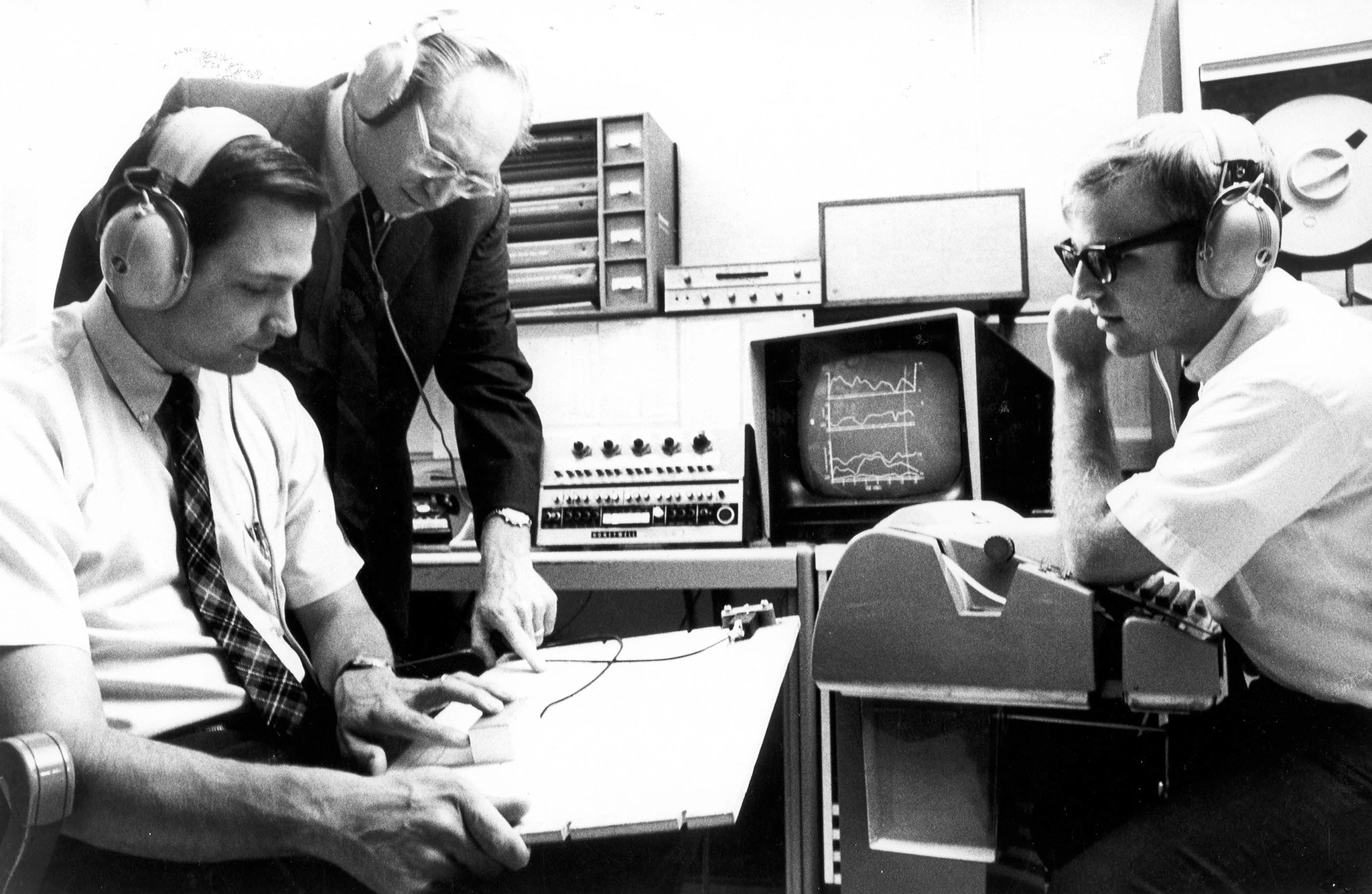
(PS: Here's a photo of one of our workstations at Bell Labs
--
http://homepage.cs.uiowa.edu/~dwjones/BellLabsLAN/DDP516workstation.jpg
R. W. Schafer, J. L. Flanagan, and L. R. Rabiner are shown with the workstation in 2D516, Bell Labs Murray Hill, as it was in 1973. Schafer is using the mouse on an aluminum panel he's got balanced on his lap while Larry Rabiner sits in front of the Model
33 with his elbow on the paper-tape punch. They're listening to computer-generated speech on the headphones. The photo is a Bell Labs publicity photo.)
______________________________________________________________
GreenKeys mailing list
Home:
http://mailman.qth.net/mailman/listinfo/greenkeys
Help:
http://mailman.qth.net/mmfaq.htm
Post:
mailto:[email protected]
>>> Jordan Spencer Cunningham's GreenKeys Search Tool:
https://teletype.net/gksearch
>>> 2002-to-present greenkeys archive:
http://mailman.qth.net/pipermail/greenkeys/
>>> 1998-to-2001 greenkeys archive:
http://mailman.qth.net/archive/greenkeys/greenkeys.html
>>> Randy Guttery's 2001-to-2009 GreenKeys Search Tool:
http://comcents.com/tty/greenkeyssearch.html
This list hosted by:
http://www.qsl.net
Please help support this email list:
http://www.qsl.net/donate.html
Message delivered to
[email protected]