I was about to mention
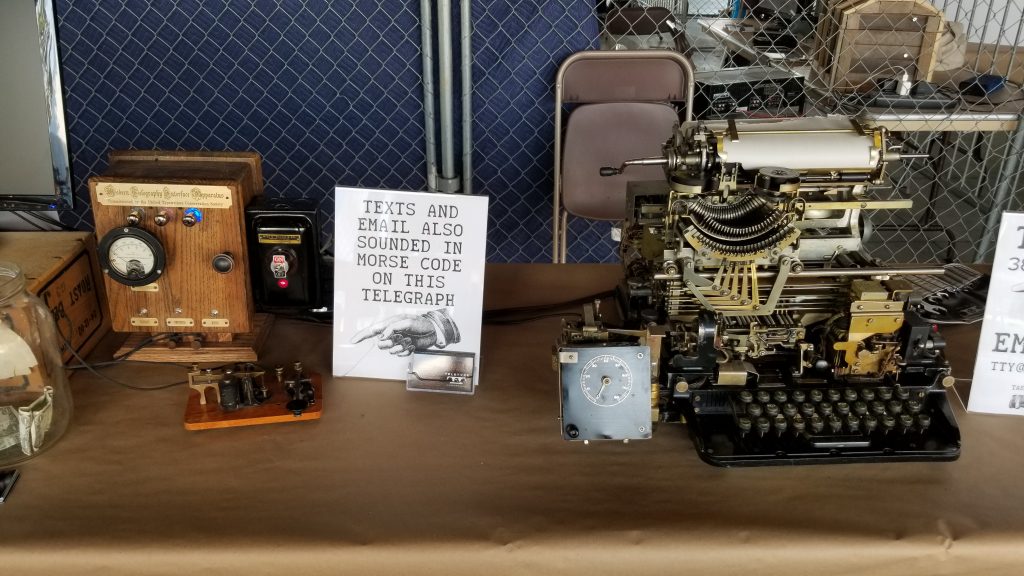
MorseKOB as an example of this exact concept. Great little program and design, and amazingly simple if memory serves (it's been a while since I got into its guts). I built an iteration of the board before I got the teletype bug and now have it (with MorseKOB 4.0, the iteration in Python) set up in tandem with my Model 19 so that emails and SMS messages get printed on the 19 while one of my sounders taps it out in Railroad Morse. It's totally raw on or off. I'm really curious now if it can be adapted to handle on/off at 45 baud-- obviously it wasn't designed with such that high of a frequency in mind. If I can ever find two minutes to rub together, I'll experiment with this as I've had the same thought of "loop over IP" type comms for a few years, just never thought to try building on what MorseKOB started.
By the way,
here's a photo of my MorseKOB setup adorned in steampunk attire (a modified old telephone ringer box with vacuum tubes, brass plates, and toggle switches, inside which is a Raspberry Pi connected to the MorseKOB IO board) sitting next to the 19 at a show a few years ago for your enjoyment.
On 8/1/2022 5:14 PM, Harold Hallikainen via GreenKeys wrote:
> I think there is a method of doing Morse over the Internet for remote
> operation of transceivers, but I don't know how it is done. To do on/off
> keying instead of, possibly, baudot to ASCII conversion and then
> transmission over TCP, I'd probably transmit the time of each transition
> to mark and the time of each transition to space. This again could be sent
> over TCP or UDP.
>
> per sample at 8 kHz sample rate. The 12 bits per sample is because that's
> the size of the ADC on the chip. All calculations are then done as double
> precision floats. In general, I think 8 bit at 8 kHz would handle RTTY
> fine.
>
> Harold
>
>
>
> ______________________________________________________________
> GreenKeys mailing list
>
______________________________________________________________
GreenKeys mailing list