2021/09/29
[150 Years of International Communications (2)] From longwave to shortwave: KDDI Yamata Transmitting Station, Japan's only shortwave broadcasting station for overseas audiences
It is now easy to make phone calls and emails with people overseas, as well as use the internet and social media. International communication has become dramatically more convenient, but behind this lies a history of challenges undertaken by our predecessors. The traces of these challenges can be seen at the KDDI MUSEUM in Tama City, Tokyo.
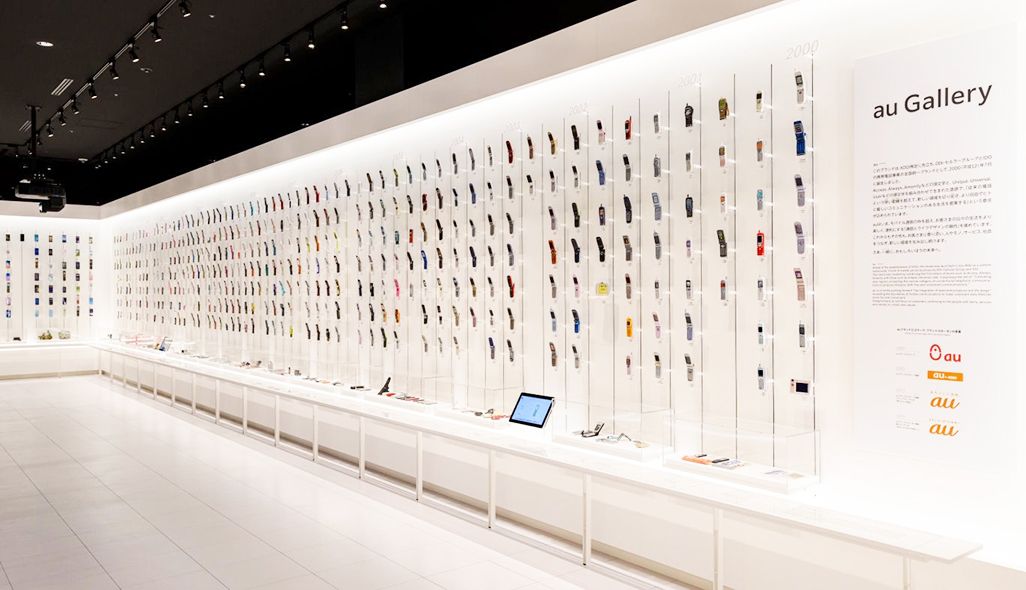
The KDDI MUSEUM explains the 150-year history of international communications in Japan through actual equipment and documents, and also displays all generations of au mobile phones and smartphones, allowing visitors to experience the latest 5G and IoT technologies.
International communications in Japan began in 1871 (Meiji 4), and 2021 marks the 150th anniversary of that. This article will introduce the history and evolution of international communications in a four-part series: "1. The beginning of international communications in Japan, " "2. From long waves to short waves - radio waves connecting the world," "3. The challenge of space, satellite communications," and "4. The era of high-capacity optical undersea cables," along with the exhibits at the KDDI MUSEUM.
International communications move from undersea cables to wireless communications
The theme of this time is "② From long waves to short waves - Radio waves connect the world." The program will cover the history of how long and short wave wireless communication, which began in the early 20th century, became the mainstream of international communication, and the role of the KDDI Yamata Transmitter, the only one in Japan currently transmitting shortwave broadcasts to overseas audiences.
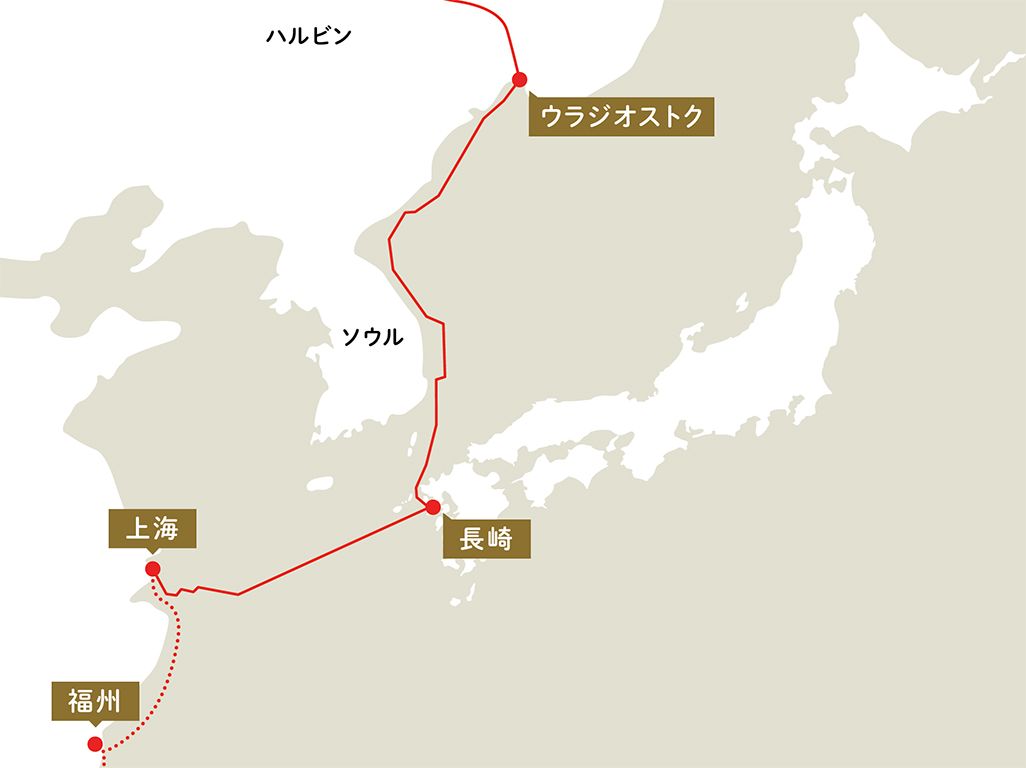
International communications began in Japan in 1871 (Meiji 4), when the Danish company The Great Northern Telegraph Co. laid long-distance connecting undersea telegraph cables Nagasaki to Shanghai and Vladivostok (Russia). As the era changed from the Meiji to the Taisho and Showa periods, international communications moved from undersea telegraph cables to wireless communications using long and short waves.
To begin with, "wireless communication" refers to a communication method that does not use wires to carry electric current, but mainly uses "radio waves." In 1888 (Meiji 21), German physicist Hertz proved the existence of radio waves and that they could travel through space, and in 1895 (Meiji 28), Italian electrical engineer Marconi succeeded in an experiment in wireless telegraphy over a distance of 2.4 km. Marconi's invention of the wireless telegraph completely changed the state of international communications.
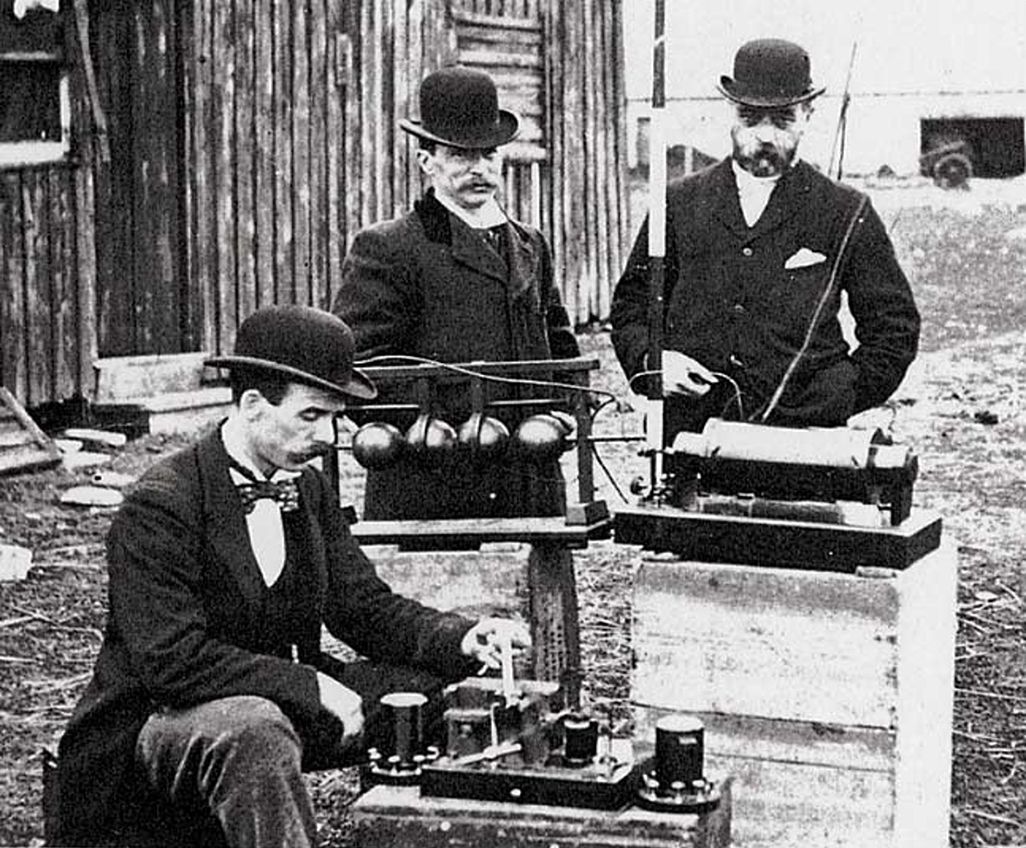 British Post Office officials testing maritime radio transmission using Marconi's equipment (1897)
From semaphore communication to space communication
Wireless telegraphy was cheaper to build than undersea telegraph cables, there was no need to land cables in other countries, and there was no risk of the cable being cut along the way.
Like Western countries, Japan also moved towards wireless communication. The background to this was that at the time, Japan's international communications were dependent on other countries, including a Danish company that laid undersea telegraph cables, and all communications with Europe and the US had to go through telegraph cables via the UK, and the international telegram charges were also high. Therefore, it was inevitable that Japan would switch to wireless communication, which it could operate independently.
Japan conducted research and development based on the wireless technology of the British fleet, and completed the Type 36 Wireless Telegraph, which had a communication range of 200 nautical miles (about 370 km), in 1903 (Meiji 36). Early wireless telegraphs were used as a means of communication between ships and shore, or between ships.
In 1905 (Meiji 37), towards the end of the Russo-Japanese War, during the Battle of Tsushima, the Shinano Maru discovered the Russian Baltic Fleet and sent the first report from its Type 36 wireless telegraph, stating "Enemy fleet sighted at location 203," leading Japan to victory and demonstrating the effectiveness and necessity of wireless communication.
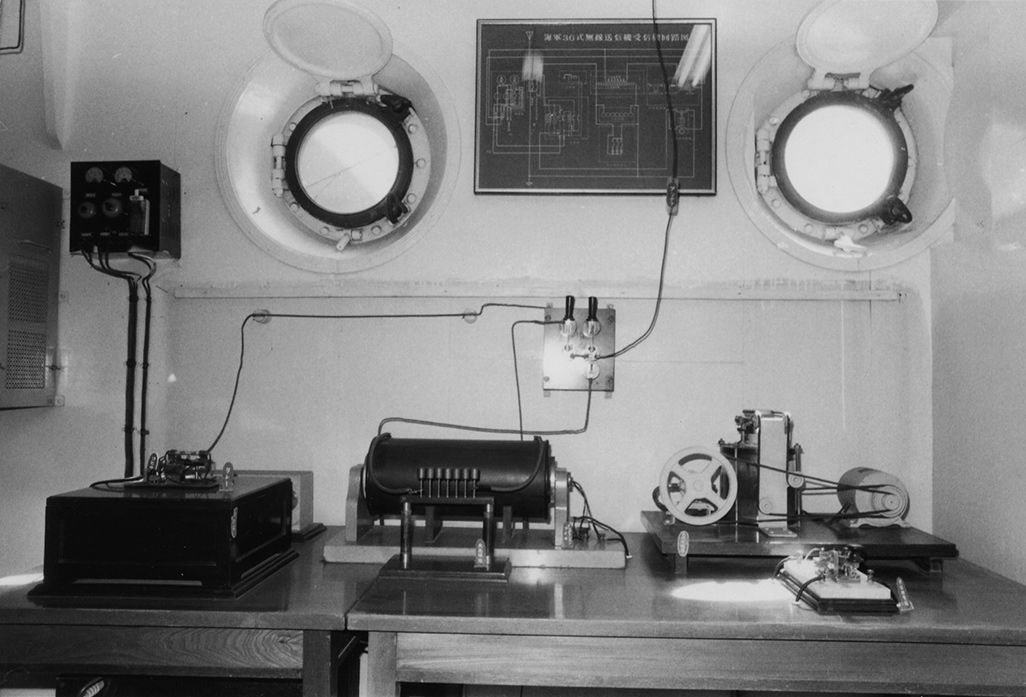 A restored Type 36 radio transmitter (stored on the Mikasa Memorial Ship, Mikasa Preservation Society, Public Interest Incorporated Foundation. Image provided by the Postal Museum collection)
Long-wave communication using high-power radio waves along the earth's surface to far-flung places overseas
As it became clear that radio waves with longer wavelengths could travel longer distances, countries around the world began to use low-frequency waves for long-distance intercontinental communications. "Low-frequency waves" refer to radio waves in the frequency range of 30 to 300 kHz (kilohertz), and have the characteristic of traveling long distances along the earth's surface.
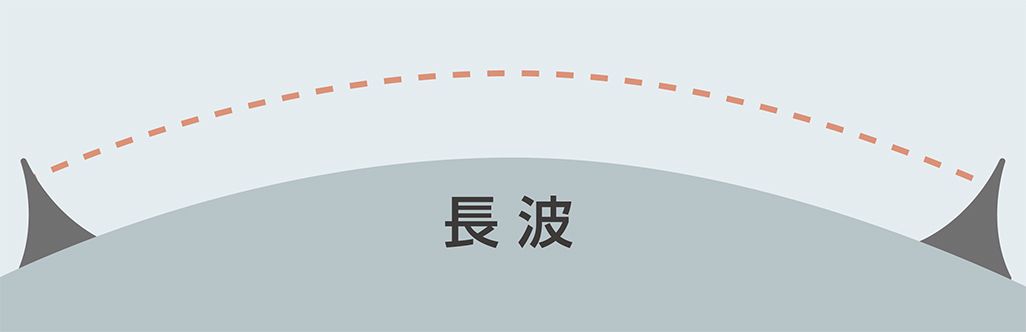 Long waves are emitted from a huge antenna
Generating long waves required large amounts of electricity and communication stations with huge antennas. In addition, there were only 134 radio waves suitable for long wave communication in the world, and the unused radio waves were available on a first-come, first-served basis , with the first country to build an international radio station being granted the right to use them.
In the race to acquire radio waves, Japan also needed to build an international radio station as soon as possible, but the national finances at the time were such that it was difficult to cover the huge construction costs. Therefore, in 1925 (Taisho 14) , the Japanese government raised funds from the private sector and established the Japan Wireless Telegraph Co., Ltd. The company would build and maintain the international radio station, which the Japanese government would then operate.
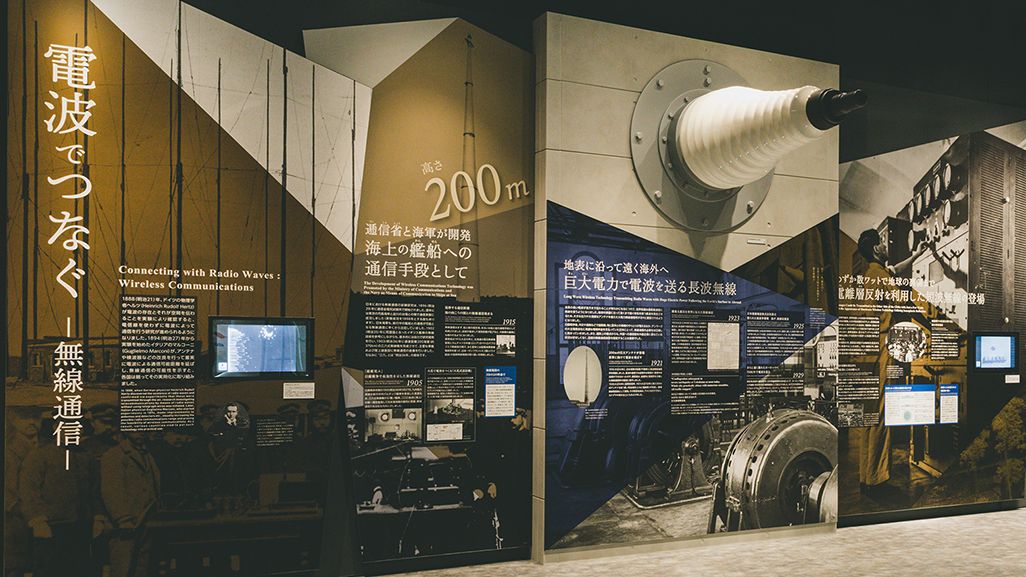 In the upper right corner of the photo is a giant insulator used in long-wave communications. It is a device used to insulate the wires from their supports.
Towards the era of shortwave radio waves reflected by the ionosphere
In the late 1920s, as competition for radio waves suitable for long waves intensified among countries around the world, the "shortwave" communication method emerged.
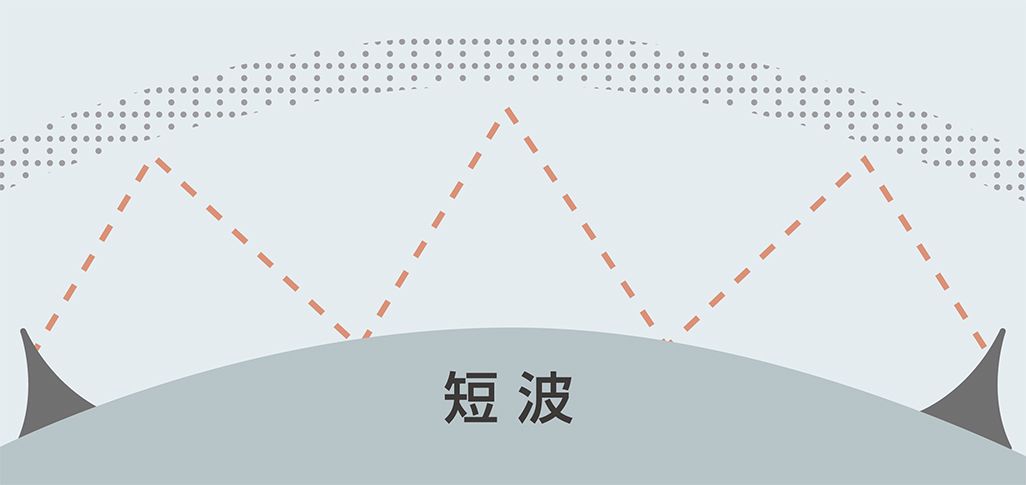 Shortwave radio waves are transmitted by reflecting them off the ionosphere and the earth's surface.
Shortwave communication, which uses radio waves in the frequency band of 3 to 30 MHz (megahertz), was initially thought to be unsuitable for long-distance communication, but it became clear that by reflecting waves off the ion sphere and geological layers, they could be sent to far-flung overseas locations with just a few watts, and the main means of international communication rapidly shifted from long waves to shortwaves. In Japan, Oyama Transmitting Station (Tochigi Prefecture) was built in 1931 (Showa 6) as a shortwave communication facility for communication with the United States, the South Seas, and the Far East.
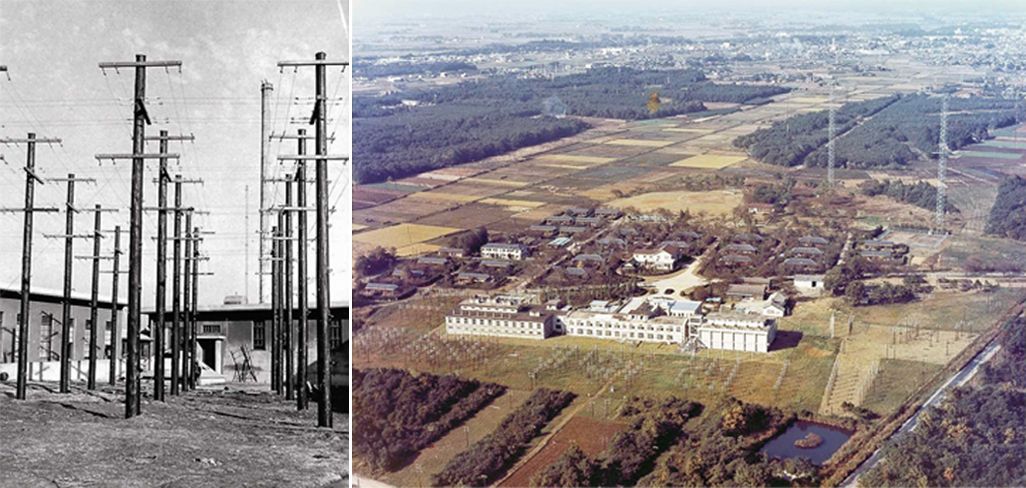 Oyama Transmitting Station (left: around 1930, right: after World War II)
1934: International telephone calls begin in Japan
As wireless communication developed, research into the practical application of wireless telephones began in various countries around the world, and in 1927 (Showa 2), international wireless telephone communication began between the UK and the US. Wireless telephone equipment spread to all major regions.
As European and American countries began establishing wireless telephone services to Asia, the Japanese government launched the International Telephone Company in 1932. In 1934, Japan's first international telephone service using shortwave radio was launched between Manila (Philippines) and the Nazaki transmitting station (Ibaraki Prefecture ) and Komuro receiving station (Saitama Prefecture) that the company had built.
By the time the Sino-Japanese War broke out in 1937 (Showa 12), it had become possible to make calls to major regions around the world, with European countries via relays in London and Berlin, South America via a relay in Buenos Aires, and the Union of South Africa via a relay in Berlin.
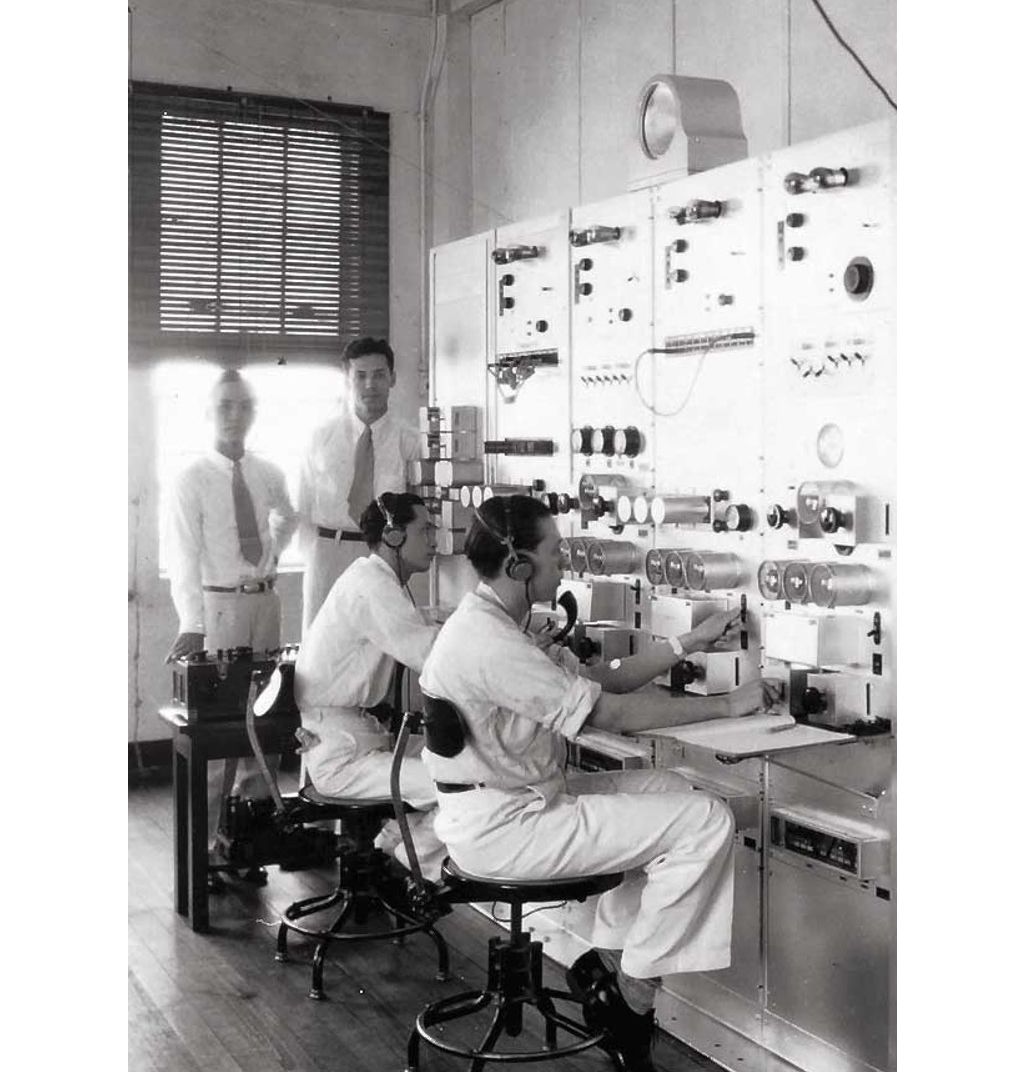 Manila station monitoring international calls with border equipment
Wireless communication also made it possible to send and receive voice and images, something that was difficult to do with the undersea telegraph cables of the time. At the 1936 Berlin Olympics (Showa 11), a live radio broadcast of the event across the ocean was made possible via international telephone lines, along with the announcement of "Go Maehata!"
In 1938 (Showa 13), Japan Wireless Telegraph Co., Ltd. and International Telephone Co., Ltd. merged to form International Electrical Communications Co., Ltd. At the time, it was said that the strength of radio waves for overseas broadcasting was proportional to the power of a nation, and in 1940 (Showa 15), the company established Yamata Transmitting Station (now KDDI Yamata Transmitting Station) (Ibaraki Prefecture) as a transmitting station exclusively for overseas broadcasting. Even today, it continues to operate as Japan's only transmitting station for shortwave broadcasting to overseas audiences.
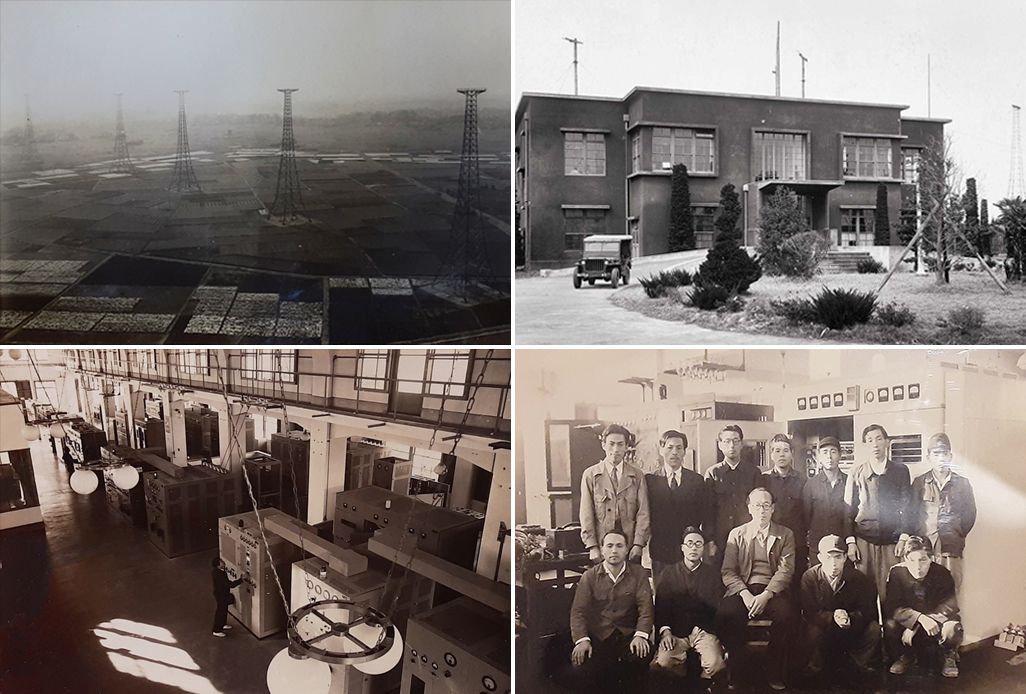 Yamata Transmitting Station in the early Showa period (now KDDI Yamata Transmitting Station)
Postwar international communications, KDD established
The first half of the 20th century was a time when the storm of war was spreading all over the world. Wireless communication by shortwave waves was not at risk of being cut by the enemy, as was the case with undersea telegraph cables, and became an indispensable means of communication for moving troops and ships. Each country used radio broadcasts and newspaper radio information (wireless telegrams sent for the purpose of being published in newspapers) to directly inform its own people of the state of the war in both voice and text, in order to boost morale.
On August 15, 1945 (Showa 20), the Emperor's voice was broadcast to the world from the Ashigara transmitter in Kanagawa Prefecture, announcing the end of the Pacific War. The shortwave broadcast conveyed the end of the war to soldiers and Japanese residents in mainland China and southern regions, as well as Japanese immigrants in South America and elsewhere.
Immediately after the end of the war, most international communications lines had been cut off, with only a few neutral countries remaining. In Japan, there was an urgent need to bring international communications services up to the level of developed Western countries, and in 1953 (Showa 28), Kokusai Denshin Denwa Kabushiki Gaisha (KDD), the predecessor to KDDI, was established as a private company to operate the international communications services that had previously been run by government agencies and other organizations. This was also the year that communications and broadcasting began to permeate our lives, with the Japan Broadcasting Corporation and private television stations commencing television broadcasting.
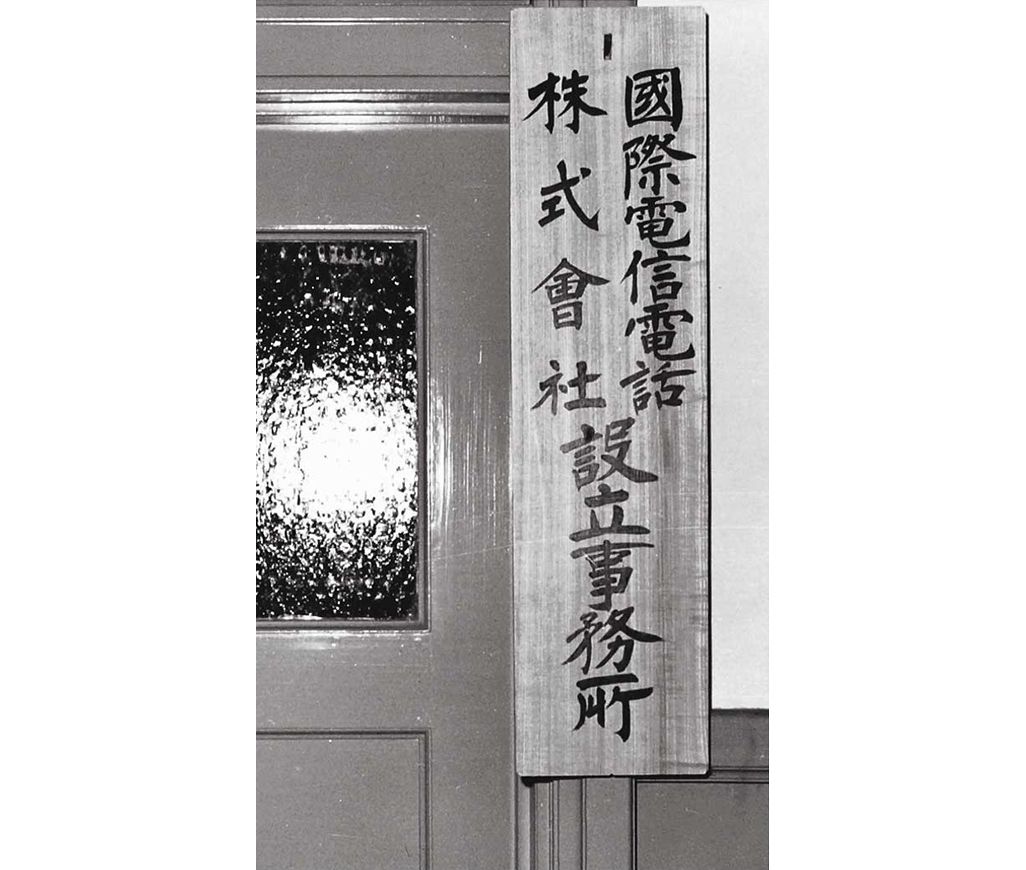 The signboard of the International Telegraph and Telephone Company's founding office located in the Ministry of Posts and Telecommunications in Mamiana, Tokyo.
Economic growth and increasing demand for international communications
When KDD was first established, it had 58 lines, including 29 telegraph lines, 18 telephone lines, and 3 photo telegram lines, mainly to North and South America, Europe, and Asia. As the demand for communications increased along with the growth of the Japanese economy, KDD expanded its communication lines and made efforts to make maximum use of its limited assets, frequencies.
As a result, by the end of fiscal 1963, just 10 years after the company's launch, the number of shortwave lines had reached 292, and at its peak the number of telegraph lines was seven times as many and the number of telephone lines was three times as many as when the company was first established.
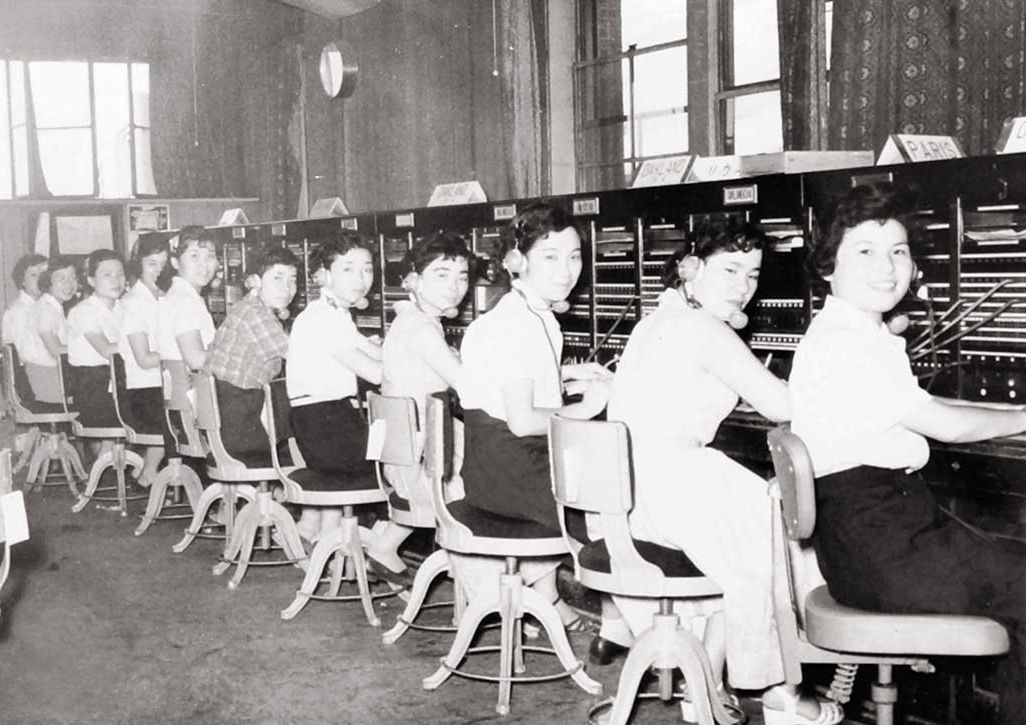 Tokyo International Telephone Office Switchboard Operator (inside Nippon Telegraph and Telephone Corporation Tokyo Toll Office)
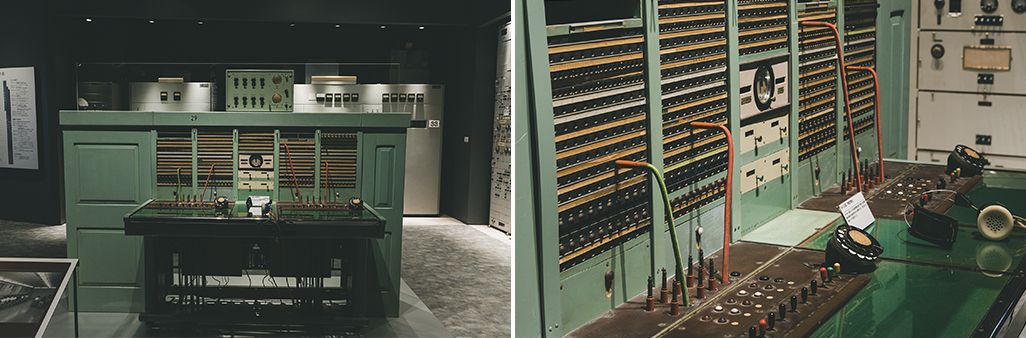 An international telephone switchboard manufactured in 1957
In 1950, the international telex service, which combined typewriters and telegraphs, began between Europe and America. What you type into a telex terminal is printed out by a printer on the other end of the line; it's like the precursor to fax.
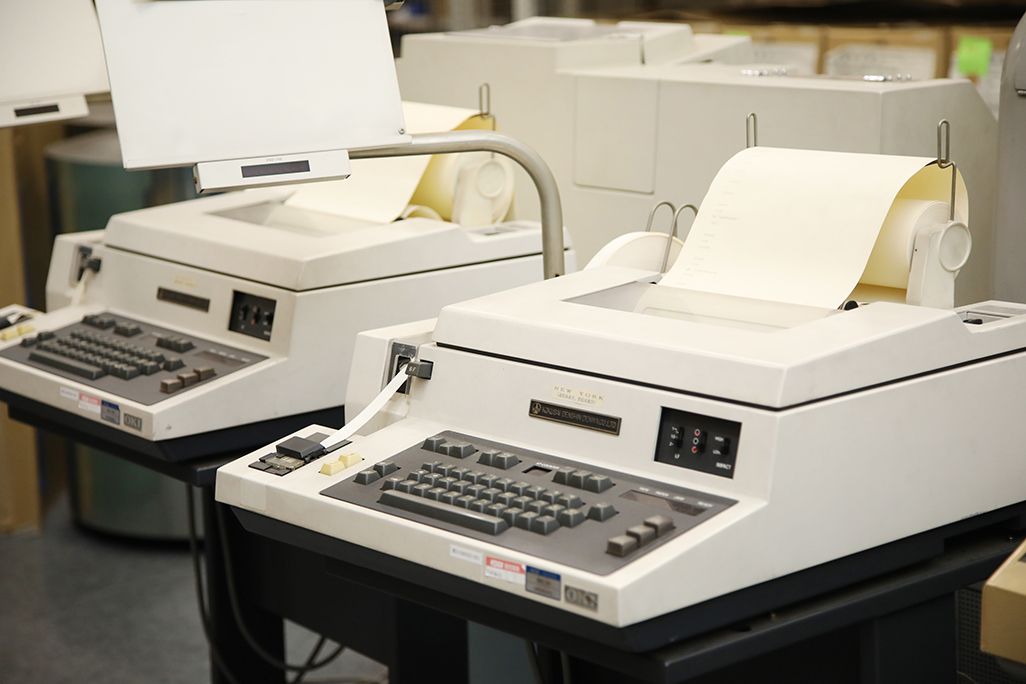 Telex terminal
KDD started an international telex service using shortwave between Japan and the United States in 1956 (Showa 31). International telex is a two-way service that allows users to communicate directly with each other, and was widely used by trading companies and banks during the period of high economic growth. The number of calls handled reached approximately 540,000 in fiscal year 1961 (Showa 36), and it grew into a major service in international communications.
After that, shortwave radio waves, which had previously been the main mode of communication in Japan, began to take over from the 1960s onwards, with satellite communications and optical undersea cables taking over.
Japan's first international phone call cost 100 yen for 3 minutes! That's one month's salary at the time!
We spoke to international communications researcher Tetsuya Ohno at the KDDI MUSEUM about some simple questions about shortwave and international telephone calls.
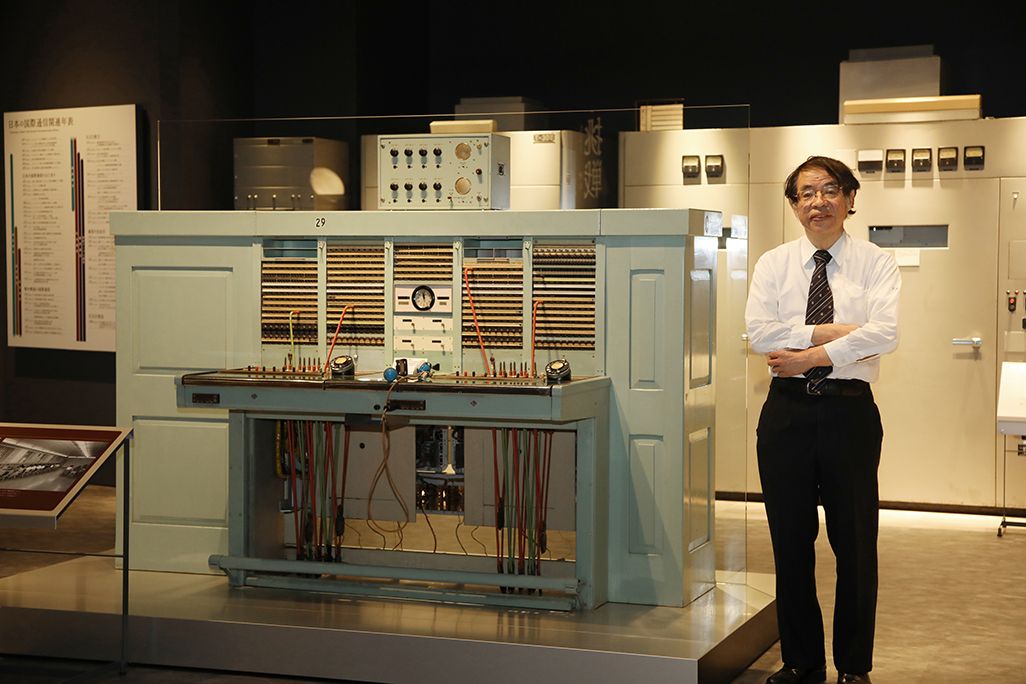 Tetsuya Ohno, a researcher in international communications
-- International telephone calls were first made in Japan in 1934 (Showa 9). What were the prices and usage patterns at the time?
"International calls cost 100 yen for three minutes. At that time, 100 yen was equivalent to roughly one month's average household income. Because international calls were so expensive, they were rarely used by individuals, and users were limited to media outlets and securities companies Companies also rarely used international calls on a daily basis, and it seems they were used as a supplement to telegrams, for example, when they needed to be contacted by the end of the day because it was urgent.
International calls were handled nine hours a day, from 7 am to 4 pm The international telephone operator would measure the actual duration of the conversation using a built-in billing meter and then manually tally up the data to calculate the charge. It seems that only a very small number of people made international calls, but the use of shortwave radio was the first prototype of international calls."
--What kind of communication was carried out using shortwave radio at that time?
"In the case of shortwave communication, radio broadcasting became more common than international phone calls. Specifically, messages were sent using NHK's overseas radio broadcasts. At the time, there were two types of shortwave broadcasts: 'overseas broadcasting' and 'international broadcasting. ' 'Overseas broadcasting' was intended to thank Japanese people living overseas, promote Japan to foreigners, and introduce culture, and was broadcast directly from Japanese broadcasting stations to foreign countries.
The other type of "international broadcasting" was relay broadcasting conducted by the two countries' broadcasting stations in cooperation. Relaying the Olympics or concerts is "international broadcasting," so it cannot be realized without the cooperation of both countries, just like international telegrams and international phone calls. In that respect, "overseas broadcasting" can be sent directly to the receiver (radio) of the other country, so it has the advantage that it can be transmitted even if diplomatic relations are severe.

NHK's "Overseas Broadcasting" began in 1935 (Showa 10) from the Nazaki transmitting station in Ibaraki Prefecture, relaying domestic broadcast programs to overseas audiences. It was particularly well received by Japanese people living abroad, and caused a stir in many countries. Then, in 1940 (Showa 15), the "Yamata Transmitting Station (now KDDI Yamata Transmitting Station)" was established as a shortwave transmitting station exclusively for overseas broadcasting, and continues to transmit shortwave broadcasts to the world today.
KDDI Yamata Transmitter, Japan's only shortwave broadcasting station for overseas audiences
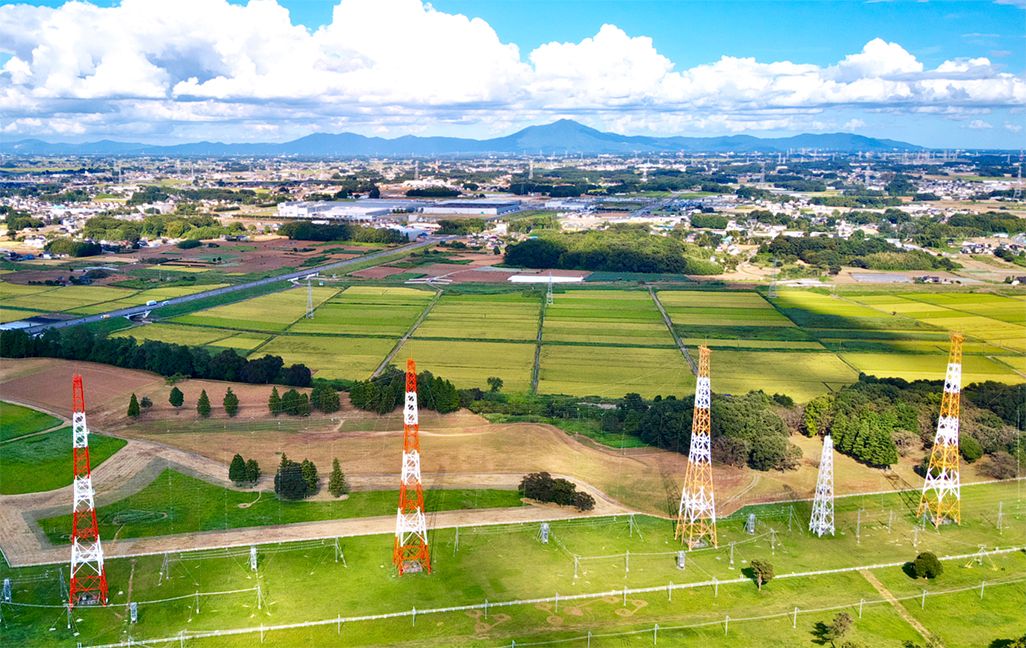
The Yamata Transmitter Station, which opened in 1940 (Showa 15), is now called the "KDDI Yamata Transmitter Station" and is the only station in Japan that transmits shortwave broadcasts to overseas audiences.
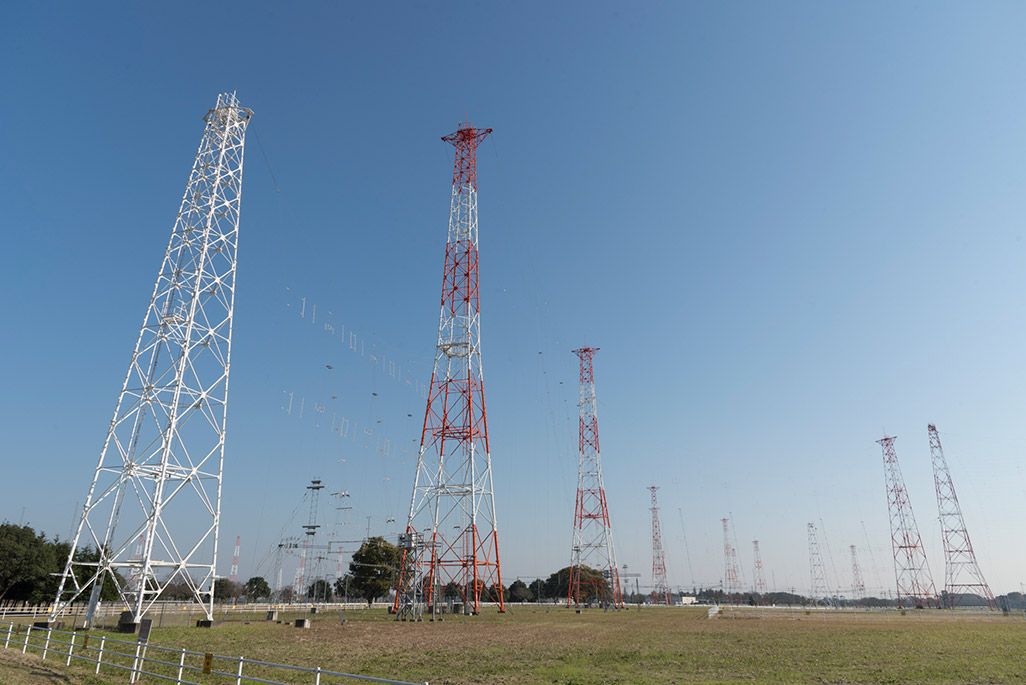
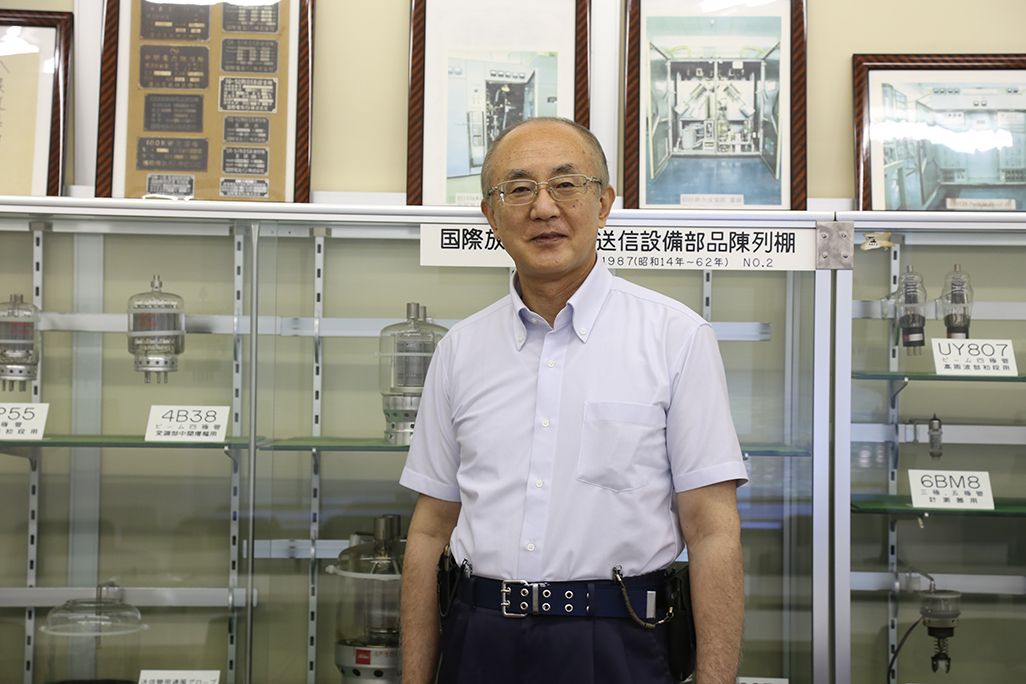
In the vast site of about 1 million square meters (22 Tokyo Domes) in Koga City, Ibaraki Prefecture, dozens of red and white steel towers are lined up, transmitting shortwave radio broadcasts (NHK World Radio Japan) to all over the world, from Brazil on the other side of Japan to Showa Station in Antarctica. We spoke with Takashi Horie, manager of KDDI Yamata Transmitting Station, about the significance of continuing to transmit shortwave broadcasts to all over the world even now, more than 80 years after its establishment .
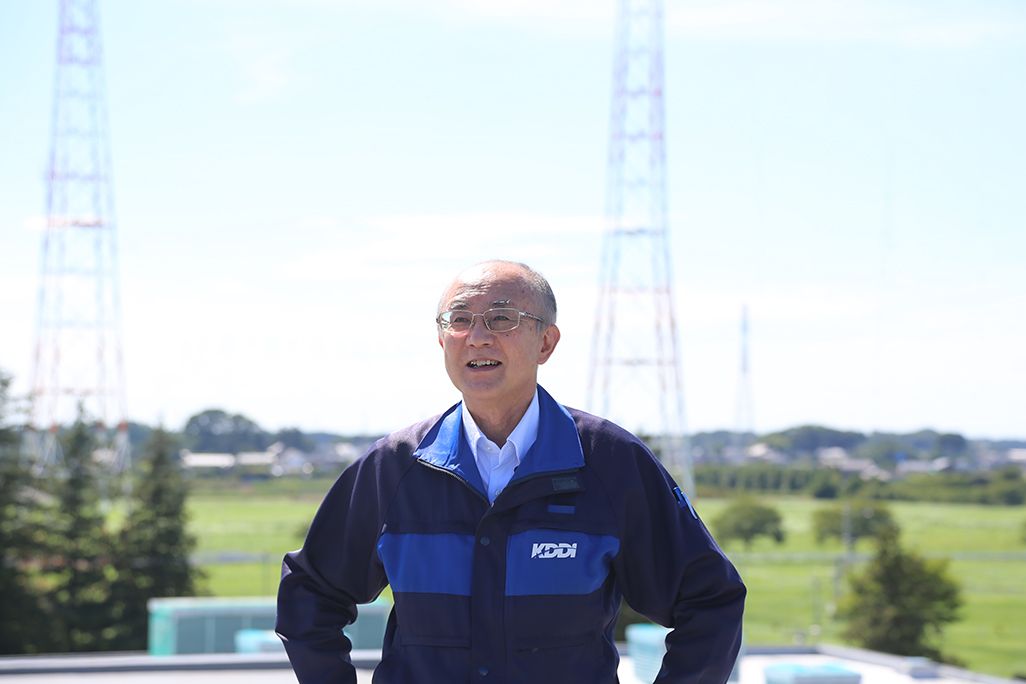 Takashi Horie, Manager of Yamata Transmitting Station, Technology Headquarters, KDDI
--What kind of broadcasts has the KDDI Yamata Transmitter Station delivered to overseas audiences up until now?
"The Yamata Transmitting Station, which opened in 1940, continued to transmit shortwave broadcasts to overseas audiences without sustaining any major damage even during the war. Until around 2008, the station would sometimes extend the time to broadcast events such as high school baseball games, the Red and White Song Battle, and the Peace Memorial Ceremony to the world, and it was apparently very popular in countries with large Japanese populations, such as Brazil.
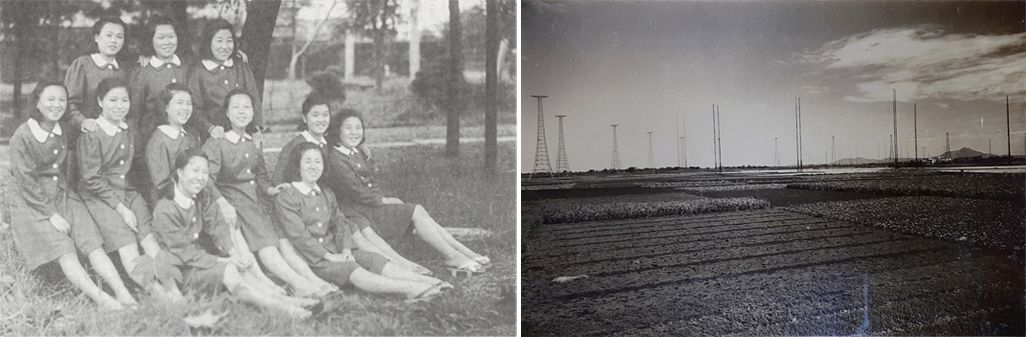 On the left is a female technician who worked there during the war, and on the right is the Yamata Transmitter Station in the early Showa period, 1944 (Showa 19).
Unlike satellite broadcasting and the Internet, shortwave broadcasting does not require large-scale facilities such as communications satellites or undersea cables. A major advantage is that any listener can receive information overseas as long as they have a shortwave radio that can receive the signals. telephones and the Internet are widespread around the world, there is a possibility that communications may be cut off in times of emergency, such as large-scale natural disasters or political unrest. Even in such cases, by transmitting information via shortwave, it is possible to convey accurate information to the world."
--Have you ever had an experience where shortwave broadcasting was useful in an emergency?
During the Gulf War in 1990, communications in the area were cut off, so Japanese nationals remaining in the area were unable to accurate information. As a result, emergency broadcasts were sent out to Japanese nationals remaining in the area. For those in the area, shortwave broadcasts were the only source of information coming from Japan.
In 2001, following the September 11 terrorist attacks in the United States, emergency broadcasts were sent out to strengthen information dissemination to the Middle East and Central Asia.
In addition, when a military coup took place in Thailand in 2014, television broadcasting was cut off in the country, so NHK World Radio Japan broadcast a special 24-hour transmission to Thailand to provide information on the situation there.
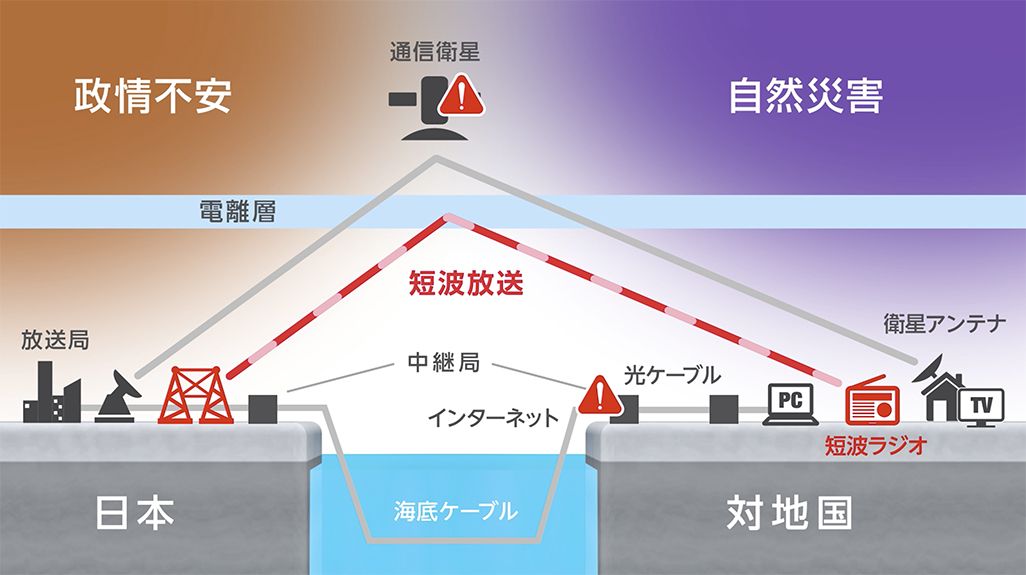 Shortwave broadcasting does not require relay stations and can transmit information even in emergencies.
"Even if there is a large-scale disaster, civil unrest, or war, as long as the Yamata Transmitter Station exists, information can be sent by shortwave broadcast. That is why the Ministry of Foreign Affairs is announcing that people traveling abroad should carry a shortwave radio."
--On the other hand, shortwave radio is showing a downward trend worldwide.
"For international communications, we can use high-capacity optical undersea cables or communications satellites, so shortwave is very inefficient from an economic standing. However, if shortwave broadcasting were to disappear, we might not be able to send information from Japan to the rest of the world in an emergency. We consider shortwave broadcasting to be in the national interest. Although shortwave broadcasting is not often listened to to in everyday life, it plays a major role in Japan's crisis management."
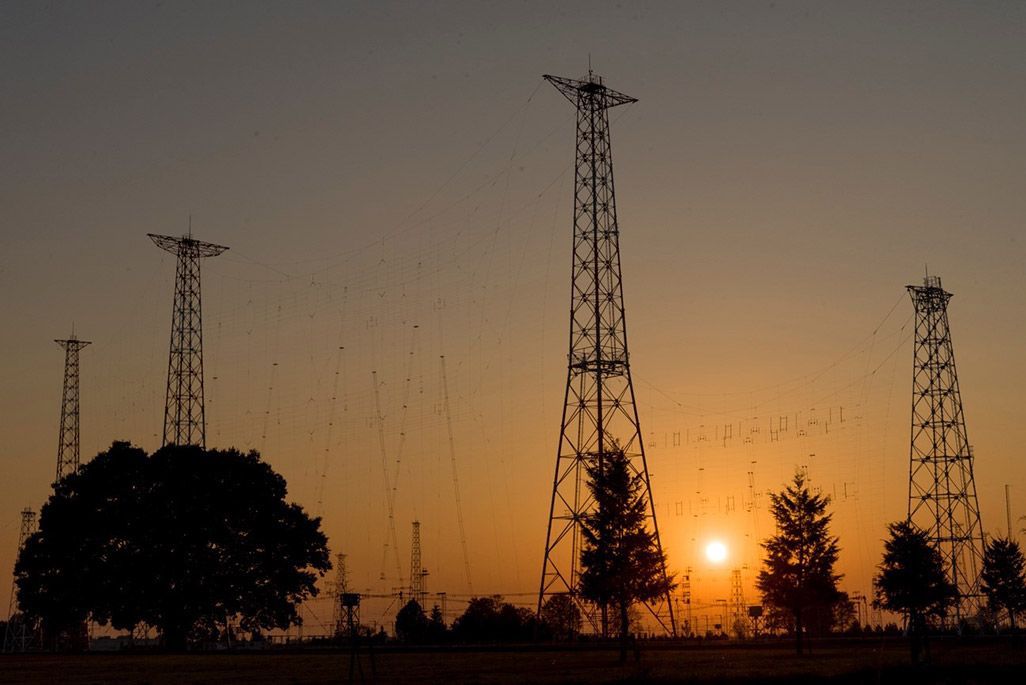
More than 80 years have passed since its establishment, and the KDDI Yamata Transmitting Station continues to transmit information from Japan to the world without interruption. Wireless communication has played an important role in international communication since the early 20th century. Then, since the 1960s, international communication has entered an era of dramatic evolution, with satellite communication and optical undersea cables taking the lead.
- want to know more
- For more information on KDDI's SDGs, click here
Tetsuya Ohno
Born in Tokyo in 1956. Graduated from the Faculty of Economics at Rikkyo University and completed a Master's course at the Graduate School of Cultural Studies at the Open University of Japan. PhD (Communication Studies/Tokyo Keizai University). Joined International Telegraph and Telephone Corporation (KDD) in 1980. After retiring, he has worked as a part-time lecturer at the Open University of Japan, among other positions. His publications include "The Century of Communications: A 150-Year History of Information Technology and National Strategy" (Shinchosha) and "Meiji Japan as Seen in the History of International Communications" (Seibunsha).