Crypto
broadcast
date, time and
formats.
The crypto broadcast will commence at 2000Z
(1300 Pacific)
on 23 July on
all KPH CW
frequencies.
The broadcast
will consist
of a 'callup'
(in plain
text)
announcing the
broadcast,
followed by
the cipher
message. The
callup and
cipher
messages will
be sent at 15
WPM. The
cipher message
will be sent
in 5 letter
groups and the
message will
be sent twice
to ensure
proper
reception.
The usual KPH channel marker or 'wheel'
running at 20
WPM will
precede the
announcement
for the crypto
broadcast to
give listeners
a chance to
tune to the
strongest
signal in
their area.
The KPH
CW frequencies
are (in kc):
426
(after an
announcement
on 500)
4247.0
6477.5
8642.0
12808.5
17016.8
22477.5
Upon
completion of
the CW
transmissions,
the broadcast
will be
repeated on
all KPH RTTY
frequencies.
The
RTTY
transmission
will be 170cps
shift Baudot,
45 baud.
The KPH
RTTY
frequencies
are (in kc):
6324.5
8427.0
12585.5
Code
Machine Key
Settings -
IMPORTANT!
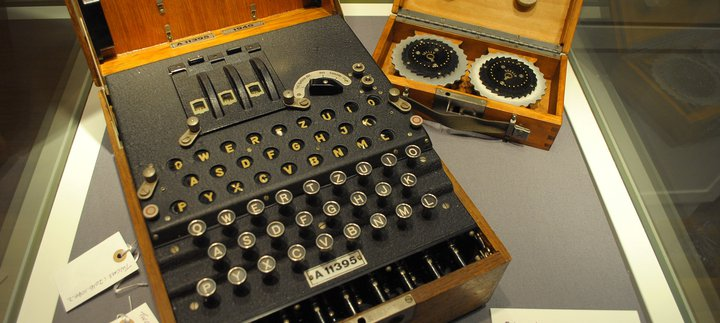
Decoding an Enigma message requires the use
of two keys: a
Daily Key
(valid for
particular
day), and a
Message Key
(unique to
each
individual
message sent
that day).
➢The
Daily Key
Prior to decoding a message, the daily key
must be set
into your
Enigma code
machine. The
daily key
settings were
specified in
codebooks and
distributed
monthly.
Please consult
the following
codebook to
obtain the
daily key
setting for
the GMT date
of the
broadcast.
Click Here for the Enigma codebook. Use the
“Armee-Stabs-Maschinenschlussel
No 28” (Army
Staff Machine
Key Number
28).
Notice each daily setting is across one line,
starting with
the first day
of the month
on the bottom
of the sheet.
➢The
Message Key
Starting in 1940, for additional security,
the machine
operator would
randomly
choose two
groups of
three letters
to encode each
message (in
addition to
the daily key
settings
above). These
were known as
the ‘message
key’. The
first group of
three letters
is used to
encode the
second group
of three. Then
the first
group (in
plaintext) and
the second
group (now
encoded) are
sent in the
message
header, along
with the date
and letter
count, as
explained in
the above
link. The
recipient then
uses the
message key to
decode the
message. For
more
information
see the
following
video on
Enigma
decoding
procedures.
Click HERE to
watch a video
on Enigma
coding
procedures.
Enigma
Simulators
So you
had to toss
your Enigma
machine
overboard when
your U-boat
was captured?
Again, no
worries. MHRS
has you
covered!
Software
simulations
exist for the
Enigma code
machine. Click
Here for an Enigma simulator. It is web-based, no
download
necessary.
Certificates
Upon proof of successful decode, the
following
certificates
will be
awarded:
- First to decode the Enigma message
- Successful decode using *original* hardware
(i.e., an
actual Enigma
machine)
- All successful decodes of the message
To apply for a certificate, send the decoded
message to
[email protected]
with the
subject line
'decoded
Enigma
message'. The
First to
Decode award
will be based
on the
timestamp of
the first
email
demonstrating
a successful
decode. For
the Enigma
Original
Hardware
certificate,
send the
decoded
message *plus*
a photo of
your Enigma
machine
showing the
daily key
setting.
Printed
certificates
will be mailed
for
‘First-to-Decode
and ‘Original
Hardware’
awards.
Certificates
for
‘Successful
Decode’ will
be emailed in
digital form
suitable for
printing at
home.
More
Information
For
more
information or
questions
about the KPH
cipher
broadcast send
email to
[email protected]
with the
subject line:
Crypto
Broadcast.