Hi Everyone.
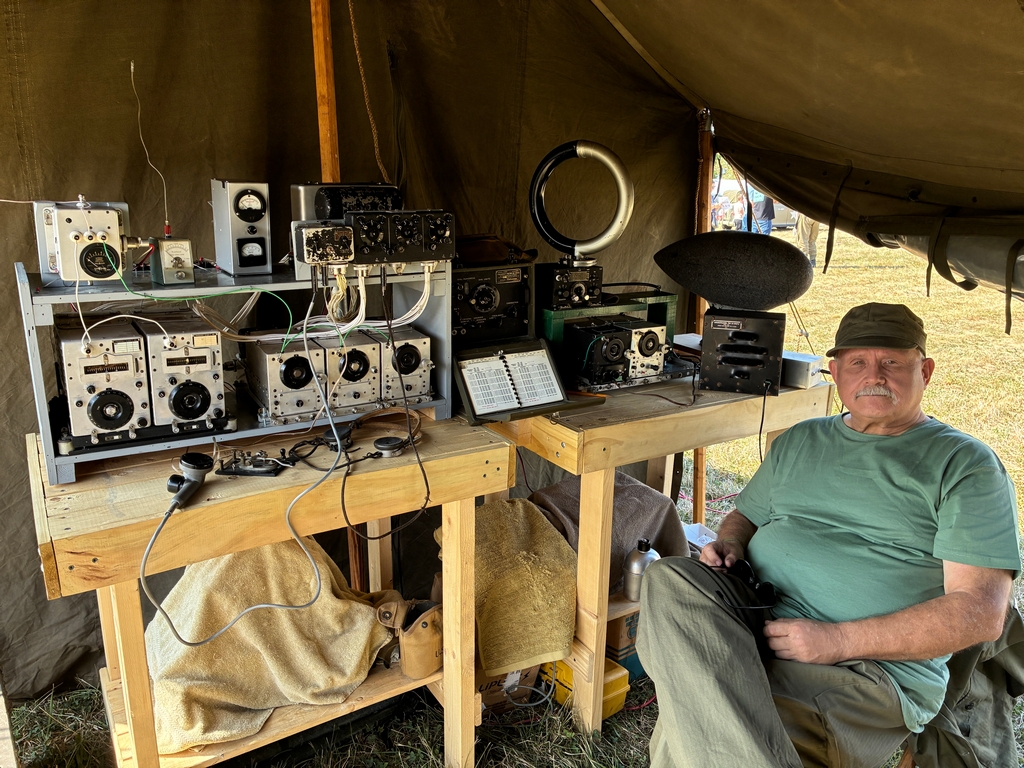
I spent last weekend participating in the World War II Weekend reenactment event at Eisenhower National Historic Site in Gettysburg PA.
Photos and videos:
www.k3msb.com/Eisenhower_Farm_2025/setup1.jpg
www.k3msb.com/Eisenhower_Farm_2025/df_1.MOV
www.k3msb.com/Eisenhower_Farm_2025/df_2.MOV
www.k3msb.com/Eisenhower_Farm_2025/cw1.mp4
Objectives:
Educate people on the HF radios used on Allied Bomber Aircraft in WW II.
Describe the differences between the Command and Liaison radios.
Demonstrate netting a receiver & transmitter using a frequency Meter.
Demonstrate how a DF unit works, and try to receive a real navigation beacon.
Equipment used:
SCR-247N. Everything is dynamotor driven.
BC-221-K Frequency Meter
Bendix DU-1 Direction Finding Unit, ARA CBY-46145 Broadcast band (500 to 1500 Kc) navigation receiver, SCR-247N BC-453 Beacon band (190 to 550 Kc) navigation receiver. All mounted on a $3 Hamfest special trashed-out FT-220-A The dynamotor supplies power to the DF unit and either receiver.
What did I expect to happen:
Use the SCR-274N to talk to others at the event (or on 75 M)
Use the DU-1 and associated receiver to illustrate how a pilot found his position, and give a general explanation of DF-ing.
Demo the SCR-274N receiver when the generator was not on to power the transmitter.
What Happened:
There were no other active HF setups at the event for me to communicate with using the SCR-274N, and I was not able to raise anyone on 3885.
Demo of the DF setup worked extremely well and was well received. I was able to demo the MW receiver during the mornings as well as the BCB during the entire event.
What went well and why:
As at the Reading Airshow in June, the DF demo went well. I had the ATA receiver tuned to an AM broadcast station and I explained how the operator would manually turn the DU-1 loop to find the maximum signal then report the bearing to the pilot (yes, I know they went for the null, but I didn't think that detail was relevant for my purposes). I explained that the DU-1 loop was normally mounted on the fuselage with an extension shaft to the operator's table, and I showed them the scales the radio operator used to determine the bearing to the station. I had an MN-36 Football next to the DU-1 for static display, and I explained that there was a loop inside the MN-36 that was motorized and worked the same way as the manual DU-1.
I was delighted to be able to receive BZJ on 328 Kc during both mornings; it is about 50 nm NE of the reenactment site. I explained what an NDB was, how it was used, and the importance of IDing the beacon with the Morse identifier.
I pointed out the dynamotor to the right of the Navigation receivers and the big TX dynamotor on the SCR-274N and explained their function – convert 28V from the aircraft electrical bus to the 200 volts needed by the vacuum tubes. I used a pair of 100 AH 12V LiFePO4 batteries in series to power the receiver and loop. I
I used a 2nd pair of Lead/Acid batteries to power the SCR-274N receivers. These were in series across my Astron 28V power supply to provide startup current for the transmitter (which turns on each time the mic button is pressed. in Voice mode.). Without the batteries the breaker will trip in the Astron power supply.
I explained the function of the command sets (short range air to ground / air to air) and contrasted that to the function of the Liaison radios (long distance). I showed them the inside of a command receiver as many of the younger people had never seen a vacuum tube. I explained what each box did and how they could be located in different parts of the airplane, and what the pilot's receiver and transmitter control boxes did.
Instead of using my MFJ Tuner and my custom box containing a 4:1 UNUN and series matching capacitor, I just used a wire antenna and counterpoise. To determine max power, I used an old Heathkit field strength meter and tuned for max reading. This worked well at my house with the antenna straight and the counterpoise running underneath it, giving me about 100 mA Ip on the SCR-274N. At the event, the antenna was bent and the counterpoise only ran under it for about 10 feet, and I was only able to get 50 mA of Ip. Still, 50 mA of Ip would be sufficient to communicate over the event area......
What can be improved and how?
As already mentioned, there were no other reenactment groups on the field to talk to with the SCR-274N. I made a point to look for BC-611's and found about 4 of them. For 2 of them, the people watching their setups had no idea who owned the 611's or anything about them. For the 3rd, the fellow had the guts removed and stuffed with a modern radio – I'm not sure to play a recording through or GMRS. The 4th was owned by a fellow at a Navy display. He knew what the 611 did and said it was original and he wanted to use it but needed to address the battery issue. We discussed options on that. He said he has two 611s but doesn't bring the 2nd as there is never anyone around to use them. We exchanged emails and plan to work together for next year's event. There was another fellow there with working radios in his Jeep, but they were on 29 Mc which I don't have. He said he had radios that would work on 75M, but he never brings them as there is nobody around to talk to. So, I took down his name as well.
It seems to be a common theme that people don't bring radios as there is nobody to talk to, and of course there is nobody to talk to if people don't bring radios. I need to be more active on the reenactment social media pages and try to get people to bring radios to the various regional events so that we can have a net going. I'm planning to do that over the winter.
Get rid of the power supply in my BC-221K and use a battery with a DC-DC converter so that the unit will be portable. This is a “nice to have”.....
Conclusion:
As with the Reading Airshow, the DF Demos were a hit, and people liked hearing CW from the 40M SCR-274N receiver. The demos of netting the receiver and transmitter to the frequency meter were well received.
In general people like seeing 85 year old stuff that still works, whether it's a radio or a Jeep. I don't think they care if I can talk to anybody (but I do.....).
I had one couple that were taking detailed photos of my radios as they said their uncle is 102 years old and was a radio operator during WW II. I hope seeing the photos brings him fond memories.
73 Mark K3MSB