The way the bands sounded today, I think it happened 😊


Bill Priakos – W5SJ

10 Free Ferry Heights

Fort Smith, AR 72903

479.461.8368


MINOR CME IMPACT POSSIBLE TODAY: Minor geomagnetic storms are possible today when a CME might sideswipe Earth's magnetic field. The CME was launched from the sun on March 6th, the aftermath of an M5.8-class solar flare. It wasn't well aimed. Only a weak glancing blow is expected, but even weak CME impacts can spark Arctic auroras. Aurora alerts: SMS Text

THE WORM MOON IN TWO HEMISPHERES: According to folklore, last night's full Moon was the Worm Moon, heralding the arrival of northern spring and the stirring of earthworms in thawing soil. Amateur astronomers Lucy Yunxi Hu and Soumyadeep Mukherjee photographed it from both hemispheres:
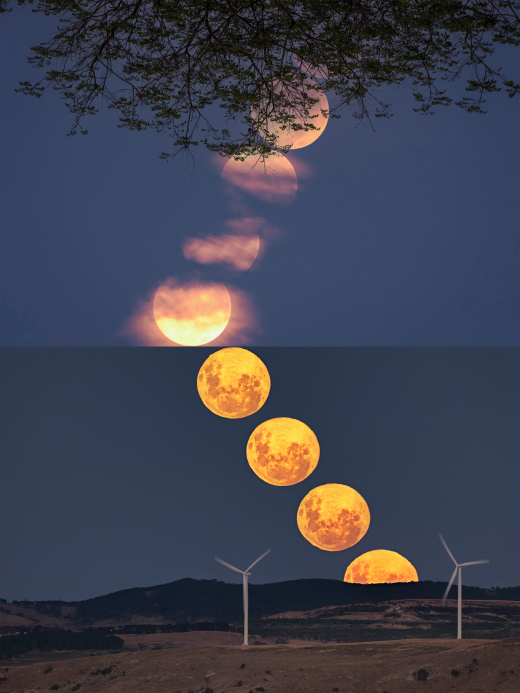
"We've been working on this project for 6 months," says Mukherjee, "and we were finally able to make it happen after overcoming a lot of challenges."

Operating their cameras thousands of miles apart, Mukherjee and Hu photographed the moonrise on March 7, 2023, from Dhanbad, India (top) and Canberra, Australia (bottom). The Worm Moon ascended the sky in different directions because Earth's eastern horizon at these two locations has a different angle relative to Earth's spin axis. "Nevertheless," says Mukherjee, "it's only one Moon!"

more images: from Eliot Herman of Anchorage AK; from Olivier Roger Staigerof Vétroz, Switzerland; from Mike Schatz of Jarrettsville, MD; from Khosro Jafarizadeh of Karaj, Alborz, Iran

Solar wind
speed: 424.8 km/sec
density: 9.35 protons/cm3
more data: ACEDSCOVR
Updated: Today at 0112 UT 

X-ray Solar Flares
6-hr max: C2 
0845 UT Mar09 
24-hr: M1  
2244 UT Mar08  
explanation | more data
Updated: Today at: 1315 UT 

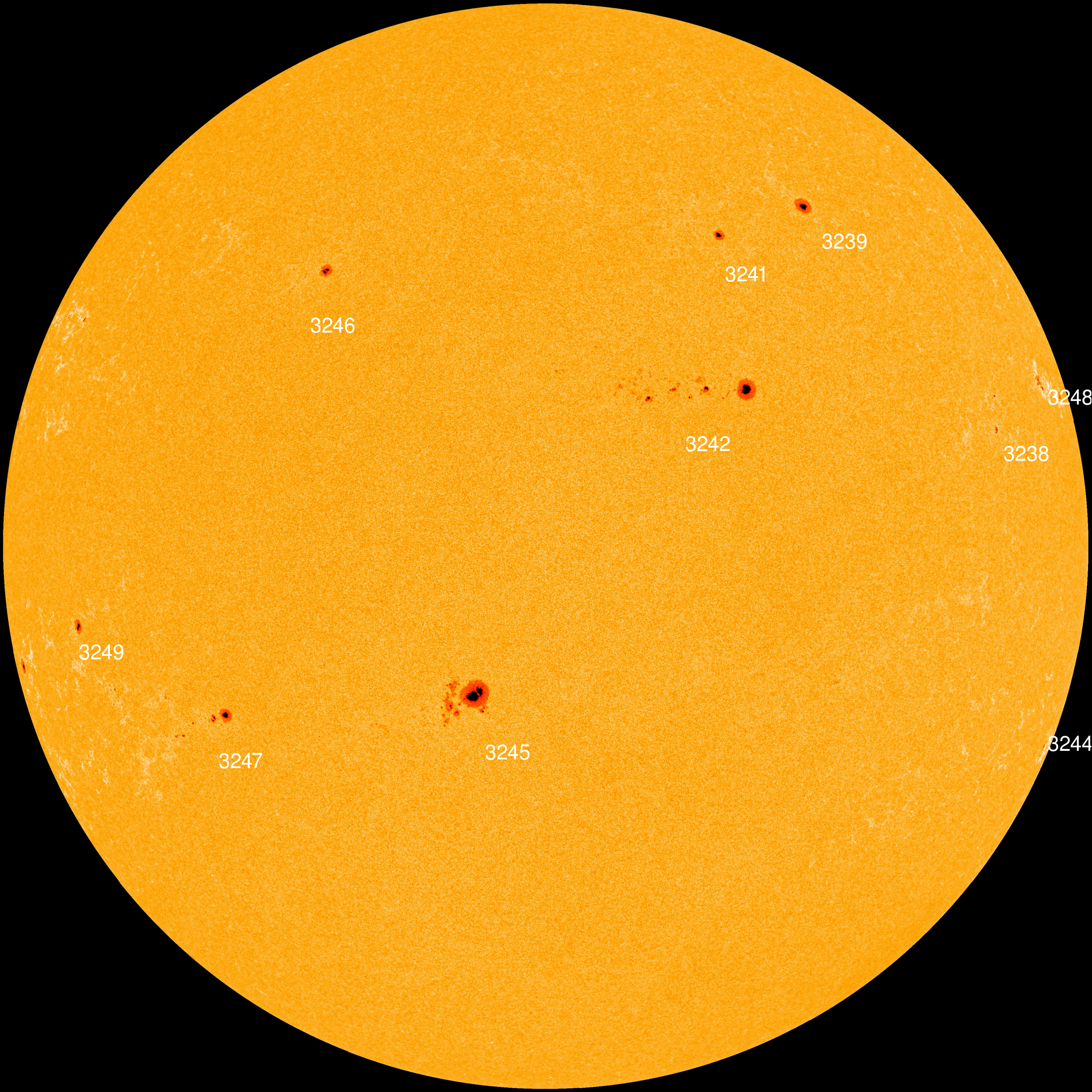
Daily Sun: 09 Mar 23 
Expand: labels | no labels


Sunspots AR3242 and AR3245 have 'beta-gamma' magnetic fields that harbor energy for M-class solar flares. Credit: SDO/HMI

Sunspot number: 146 
What is the sunspot number?
Updated 09 Mar 2023

Spotless Days
Current Stretch: 0 days
2023 total: 0 days (0%)
2022 total: 1 day (<1%)
2021 total: 64 days (18%)
2020 total: 208 days (57%)
2019 total: 281 days (77%)
2018 total: 221 days (61%)
2017 total: 104 days (28%)
2016 total: 32 days (9%) 
2015 total: 0 days (0%) 
2014 total: 1 day (<1%)
2013 total: 0 days (0%)
2012 total: 0 days (0%)
2011 total: 2 days (<1%)
2010 total: 51 days (14%)
2009 total: 260 days (71%)
2008 total: 268 days (73%) 
2007 total: 152 days (42%)
2006 total: 70 days (19%)

Updated 09 Mar 2023


Thermosphere Climate Index
today: 24.10
x1010 Warm
Max: 49.4
x1010 Hot (10/1957)
Min: 2.05
x1010 Cold (02/2009)
explanation | more data: gfxtxt
Updated 08 Mar 2023

The Radio Sun 
10.7 cm flux: 182 sfu
explanation | more data
Updated 09 Mar 2023

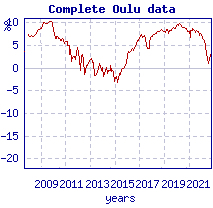
Cosmic Rays Solar Cycle 25 is intensifying, and this is reflected in the number of cosmic rays entering Earth's atmosphere. Neutron counts from the University of Oulu's Sodankyla Geophysical Observatory show that cosmic rays reaching Earth are slowly declining--a result of the yin-yang relationship between the solar cycle and cosmic rays.

Oulu Neutron Counts

Percentages of the Space Age average:
today: +0.6% 
Elevated
48-hr change: +1.8%

Max: +11.7% 
Very High (12/2009)
Min: -32.1% 
Very Low (06/1991)
explanation | more data
Updated 09 Mar 2023 @ 0700 UT

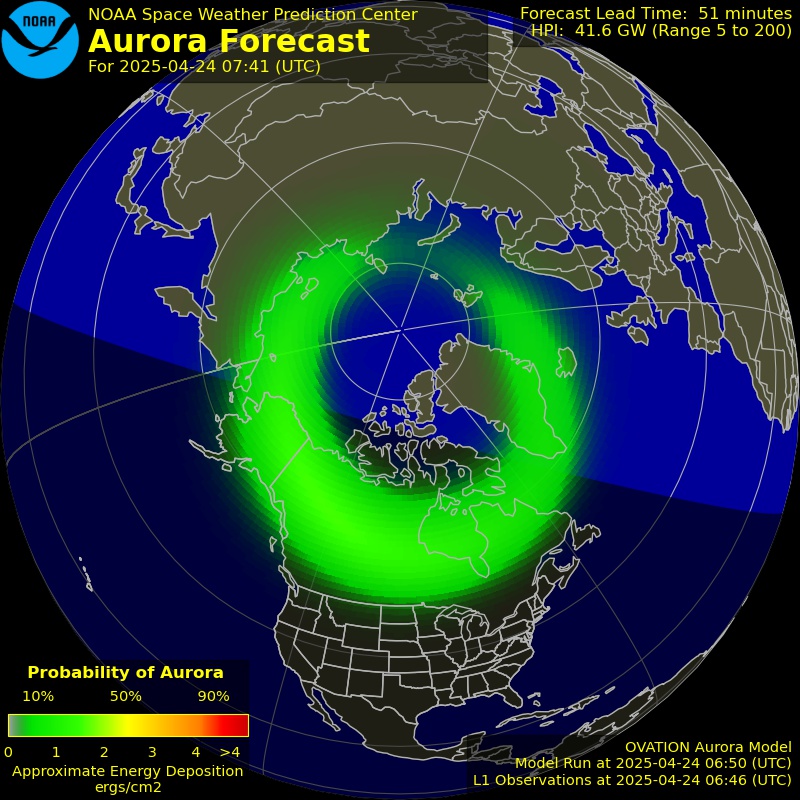
Current Auroral Oval: 

Switch to: Europe, USA, New Zealand, Antarctica
Credit: NOAA/Ovation

Planetary K-index
Now: Kp=
 3.67  quiet
24-hr max: Kp= 4.33 
unsettled
explanation | more data

Interplanetary Mag. Field
Btotal5.74 nT
Bz-4.66 nT south
more data: ACEDSCOVR
Updated: Today at 0111 UT 

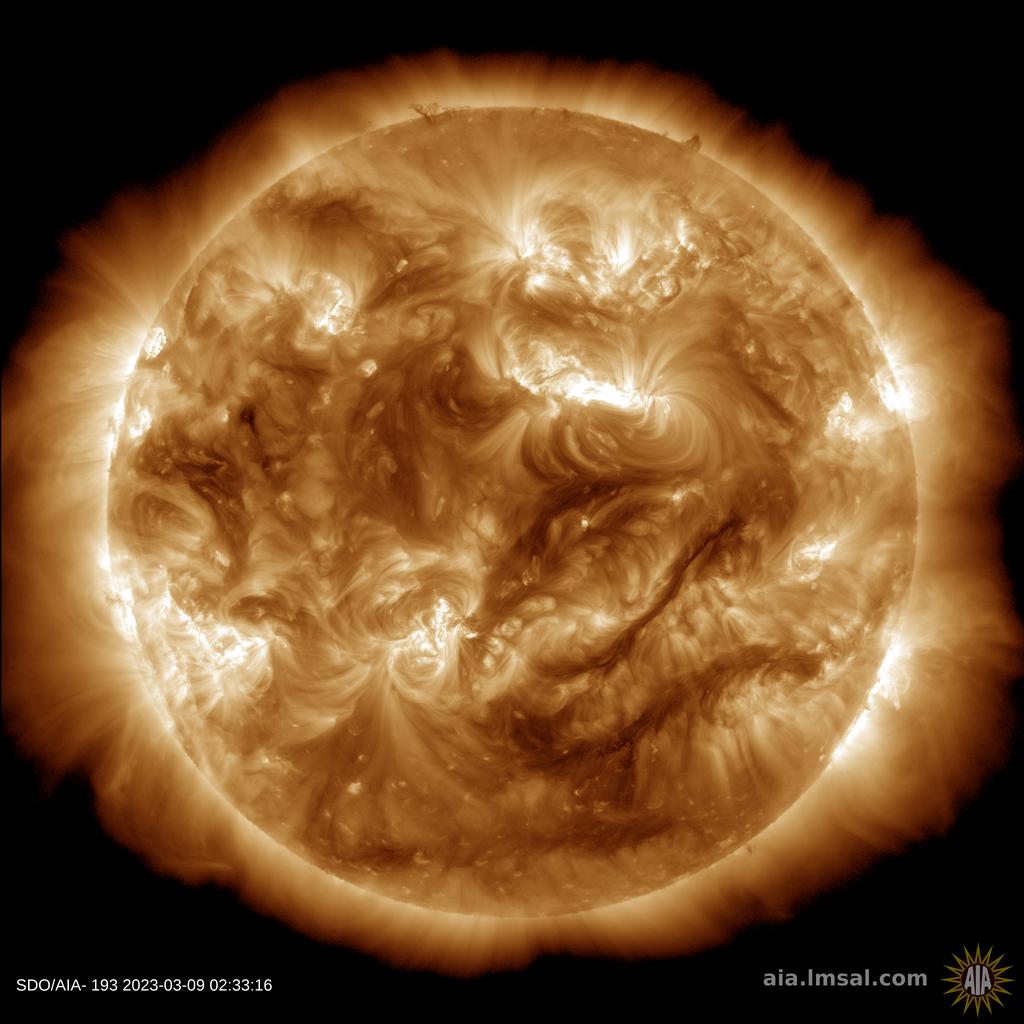
Coronal Holes: 09 Mar 23


There are no significant coronal holes on the Earthside of the sun. Credit: SDO/AIA


Noctilucent Clouds 
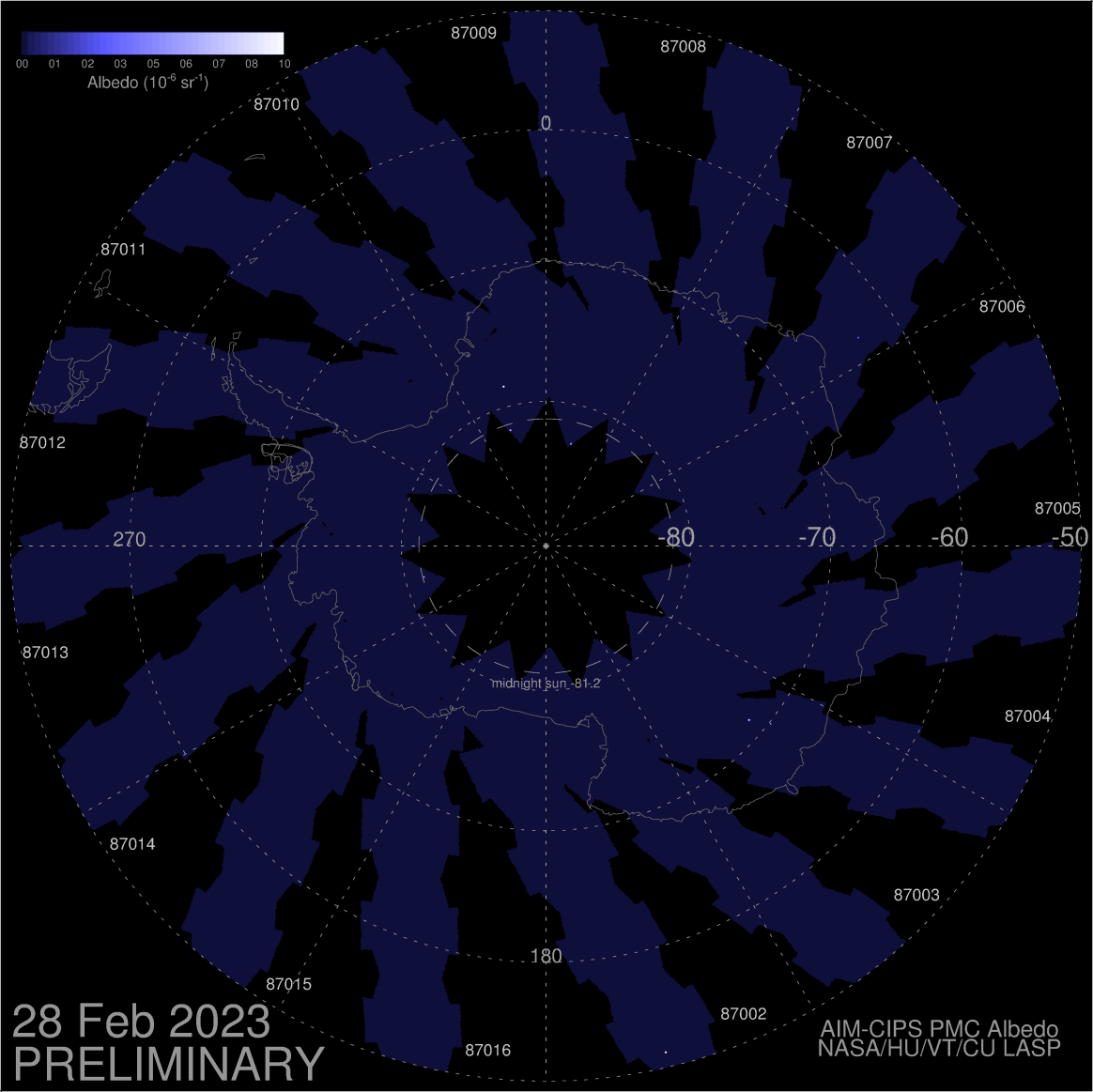
The southern hemisphere season for noctilucent clouds has begun. NASA's AIM spacecraft detected the first electric-blue puffs over Antarctica on Dec. 1st.


Switch view:Ross Ice Shelf, Antarctic Peninsula, East Antarctica, Polar 

Updated Mar08 


SPACE WEATHER
NOAA Forecasts


Updated at: 2023 Mar 08 2200 UTC


FLARE

0-24 hr

24-48 hr

CLASS M

40 %

35 %

CLASS X

10 %

10 %


Geomagnetic Storms:
Probabilities for significant disturbances in Earth's magnetic field are given for three activity levels: activeminor stormsevere storm

Updated at: 2023 Mar 08 2200 UTC

Mid-latitudes 

0-24 hr

24-48 hr

ACTIVE

20 %

15 %

MINOR

05 %

01 %

SEVERE

01 %

01 %


High latitudes 

0-24 hr

24-48 hr

ACTIVE

15 %

15 %

MINOR

25 %

20 %

SEVERE

25 %

20 %


SpaceWeather.com